Thursday, August 16, 2018

Travel Days

We pulled out of Twillingate on Wednesday, the 15th and drove to the base of the Northern Peninsula where we camped at the Jackladder RV Park on Bonne Bay Big Pond.  It was a beautiful evening.  Then in rained all night and part of the morning.  IMG 7176

Before we started off to St. Barbe near the point of the peninsula we stopped in the Newfoundland Insectarium and Butterfly Pavilion where we walked among fluttering butterflies from Costa Rica but not really as the weather was too cool for them and they mostly just sat on the leaves and limbs looking pretty.  We also learned about the life cycle of honey bees and perused the many display cases of beetles, bugs, moths and spiders. They had an impressive number of walking sticks, some tarantulas and a cool looking millepede.  

The rest of the day was spent driving along the coast of the Gulf of St. Lawrence enjoying the fishing villages and watching for moose, which we spotted only one and that was at a distance and driving 45 mph. The farther we get away from the main population center on the east coast of the island, the worse the roads get. It’s a full time job for John trying to miss the potholes and dips in the road.  It is still rainy and very cool.  

Tuesday, August 14, 2018

French Beach to Spillers Cove

IMG 7159We’ve had enough of museums and needed to get some exercise so we hiked out on the point at the end of Durrell Street.  Newfoundland has a very rugged coastline so it was a bit of a challenge to climb up the cliffs and walk along the top but it was worth the effort. The views were stunning.  We couldn’t believe how calm the waters were today. Yesterday the wind nearly knocked us over and today it was very quiet. Our hike was about 5 miles long.  IMG 7160

This evening we attended The Split Peas production.  These are 6-12 retired ladies who all sing, some play guitar or accordion but it is all close harmony.  At the intermission we got to eat Touton with molasses or jam and drink hot tea.  Touton is bread dough that is fried instead of baked. They got us up dancing, singing along with some songs and playing the Ugly Stick.  It was a fun evening.

Monday, August 13, 2018

Twillingate

P1040405Prime Berth Fishing Museum was nothing like what I thought it would be.  Dave, a Newfoundlander fisherman who still fishes, took us down to his dock and demonstrated how to cut a cod.  Once it is slit down the middle he removes the liver and puts it in a bucket to rot (that is how you get cod liver oil), then he disposed of the rest of the innards through a hole in the floor. Next you cut off the head, remove its tongue and cheeks to eat and something hard from the head that can be used to tell the age of the cod. Next you slice off the spine and feed it to the fish.  This causes the cod to be flat so you can filet the meat from the skin before dumping a large handful of rock salt all over it.  It is then placed on drying racks before being put in a barrel and sold. Or at least that’s how it was done for 100s of years. Now the fisherman just guts the fish in the boat and the cod is shipped whole and sold to a processor.IMG 7147P1040404

Dave had at least 4 other buildings with antiques from top to bottom, two full sets of whale bones and a gift shop. The whales had died before he got them so he dragged one out to an uninhabited island and let it rot for 3 years before cleaning off the blubber and putting the bones all back together.P1040407

In the afternoon we visited another museum, learned about polar bears which sometimes show up on the island, and then did a wine tour and tasting at Auk Island Winery.  Don’t get too excited, this was a fermented beverage made from wild berries, rhubarb, and strawberries. It was way too sweet for our taste.

The evening was spent at Twillingate NWI Dinner Theatre for food, laughter and music.  

Sunday, August 12, 2018

9/11 Reminder

On our way to Twillingate we stopped at the North Atlantic Aviation Museum located in Gander.  When the era of flight got better and flights got longer, this city became an important stop over for refueling before heading across the Atlantic.  Towards the end of WWI more airplanes were being used to fight the war then during WWII they became even more essential.  Over 10,000 planes were ferried across the ocean from Gander to Ireland or England.  When commercial flights started they would stop in Gander to refuel but as the planes got faster and jet engines became predominant the need to the stop over became unnecessary.P1040386

The air strip was still in use on September 11, 2001 when airspace over the US was closed down. Gander was the only place many of the large passenger jets could land.  Over 43 flights were diverted to Gander with over 6,700 people needing food and shelter.  The fine folks of Newfoundland stepped up and took care of all of them either in their private homes or by providing food, bedding or clothing to those that were stranded here.  It was more than four days before the planes were allowed to leave and to take their passengers home.P1040394P1040400

Our RV park is right on the bay where we witnessed an amazingly beautiful sunset.

Saturday, August 11, 2018

The Discovery Trail

Today Janet and Mellow joined us in the Jeep for a circle tour from Bonavista down to Trinity, on down to Port Rexton then over to Duntara and up to Amherst Cove and back to Paradise Farm RV Park. This route covered most of the tip of the peninsula.P1040358

Historic Port Union is our first stop after walking past row houses used by the seasonal fishermen from the early 1900’s. Port Union was built in 1916 by William Coaker and was the headquarters for the Fishermen’s Protective Union, the first union to protect the fishermen from people like James Ryan, whom I wrote about yesterday. Mr. Coaker brought electricity to Port Union in 1918, secured a railroad branch, a shipyard, factories, a salt fish plant and retail store turning Port Union into a very self-sufficient town. But he is best know for his newspaper, The Fishermen’s Advocate. The museum detailed his life, his newspaper, his woodworking factory and some of the history in the making during 1910-1930.P1040368P1040369

We left town via a dirt road that we hoped would take us out to a point but it got a little too rugged for Janet’s taste so we turned around. Trinity was our next stop.  This quaint village has been turned into a tourist destination due to its beautiful historic homes, forge and churches.  St. Paul’s Anglican  Church (at one time it was a Methodist Church) was particularly beautiful with an unpainted wood interior, decorative pipe organ and old headstones mounted on the walls commemorating the many people who have worshiped there since 1730. We shopped some, ate a nice lunch and then hiked up a long hill to try some highly rated ice cream while looking over the bay and village.P1040373P1040375

At another cove we drove out to the point until the steep hill and invisible track stopped us but the view was very pretty from on high. 

P1040382

We cruised the east coast a little further, spotted a moose, then cut across the peninsula to check out the bays and coves on the west side. Our final stop was at the Bonavista Social Club where we had a beer and shared a pizza while enjoying the scenery.  We again tried to drive out to a point but turned around when it seemed to never end.

John ended the day with a fishing rod in hand but not fish.

Friday, August 10, 2018

Bonavista or Good View

So far the nippers have not been too bad, too windy I’m guessing, by!  Translation - nippers are mosquitoes.P1040349

Fishing was a huge industry in Newfoundland over the past 500 years, especially for cod, until about 25 years ago. Not only were Newfoundlanders over fishing the North Atlantic but huge ships from other countries were also out there hauling in as many as they could.  Around 1986 the local fishermen started noticing a decline in the number of fish they were catching and tried several times to warn the government that they needed to do something but nothing happened until 1992 when all hell broke loose.  The government but a moratorium on cod fishing and put over 35,000 fishermen and their families out of work. They tried re-education, re-training, moving to other parts of Canada to find jobs but fishing was all these folks have ever known.  It was very hard on them and they are still very bitter about it even though they are starting to turn things around through tourism and other manufacturing jobs. They are hoping that the cod numbers will return but other countries are still over fishing the seas.P1040352P1040350

Our first stop was Ryan Premises National Histori Site where Mr. James Ryan was the owner, operator and selfish businessman of the company store and fish factory circa 1900. We visited his home, store and warehouses to learn the story of the fishing industry and catastrophe as well as to learn about the life of the fishermen before technology came around. It was a hard, labor intensive existence of fishing, dressing the fish, drying and salting the cod, storing it in barrels and then trying to get some money from Mr. Ryan so they could live and go out and do it all again. Of course, Mr. Ryan’s home was that of a rich merchant.P1040353P1040355

Down the road we stepped onto a reproduction of the ship, Matthew, that was captained by Giovanni Cabot (aka John Cabot) and sailed to Newfoundland in 1498, just a few years after Columbus.  It would have carried 20 men and took four weeks to reach land they thought would be a way to the spice islands.  All they found was bountiful land and seas but that was enough.It only took two weeks to get back so he could claim the land for Britain.

We had lunch at a local tea house where I tried the Newfoundland traditional foods of salt fish Brewis, fish cakes, beans and bologna. Brewis is cod boiled with hard bread and seasoned with scrunchons.  It was delicious!!IMG 7095

Around the corner from the ship was the home of Senator Bradley, The Mockbeggar Plantation (mockbeggar means bog or marsh).  Even though he lived in the home until late 1980’s it has been restored back to 1939 when he was living there with his family.  It has all original furnishings except for some wall paper and flooring.  The library was added on to the house in the late 1940’s so that Mr. Bradley had a place for his pipe organ.IMG 7100IMG 1724IMG 7099

It was just a short ride out to the point where the Cape Bonavista Lighthouse is located.  Not only did we tour the lighthouse and the light keeper’s home but we saw puffins on the island nearby and watched three whales out in the waves.  We believe they were sperm whales but not sure.  Of course, they come up, spout, flip a tail and they are gone so it is impossible to get a picture.  

IMG 1726

The lighthouse is located near Dungeon Provincial Park with stunning shorelines and rock features.IMG 1727

We then drove to Elliston where we saw even more Puffins.  These were a little closer but still not close enough for a good picture.  It also began spitting rain and the wind nearly blew us off the rock!

Thursday, August 9, 2018

Paradise Farm RV Park

We are enjoying Newfoundland so far.  The people are really nice, their speech is so much fun to listen to and the names of their towns can be very funny like: Chance and Come By Chance; Hearts Content, Hearts Delight, Hearts Desire, and Little Hearts Ease;  and Dildo (a device used to keep oars on a boat in their lock). The scenery along our route is beautiful with lots of green fields and more ponds (aka lakes) than in Minnesota! Still no moose sittings.IMG 7073

We are staying in a nice RV park run by a very funny young man!  He had us in stitches with his stories of how he came to own and operate this park then he ran off a list of places we should visit and good places to eat within a 30 mile radius of his park. We asked about seeing a moose and he said they were all up high where its cooler. John asked about fishing and the young man said he would turn his head and John could fish without a license.  I don’t know when he thinks he will have time to fish though!  I think we are going to enjoy this place.

Wednesday, August 8, 2018

Military Tattoo

P1040332P1040334No!  This most definitely has nothing to do with ink!  The word ‘tattoo’ comes from the Dutch phrase doe den tap toe and means “Turn off the tap”.  You beer drinkers might figure this one out.  It was a drum or trumpet sound for the bars to close down and send the soldiers back to the barracks. P1040338P1040342

What we saw today was a drum and fife corp doing precision marches in costumes from the 1800’s British, the late 1800’s Newfoundland, and Newfoundland’s army of WWI.  Each corp had their own show and at the end we stood for the God Save the Queen, Oh, Canada and Newfoundland’s national anthem.  It was quite impressive, especially when we realized it was mostly girls and young men marching.P1040344

We had a nice lunch, did some shopping in the downtown area and finished off the afternoon with MooMoo Ice-cream!

Tonight six of the ladies are going to hear a Jewish French lady who was a spy during WWII.  Looking forward to hearing this 98-year old lady share her memories.

Tuesday, August 7, 2018

St. John's, Newfoundland

Newfoundland was discovered by John Cabot in 1490, was settled by the French, fought over by the British, then the French and eventually the British won out in 1853.  Our bus tour took us around the town where we saw some beautiful Victorian and Gothic homes as well as the Jelly Bean Row or Crayola Corner houses.  They love the bright colors in St. John’s.P1040294P1040296

We stopped briefly in Quidi Vidi (pronounced Kiddy Viddy), a quaint fishing village on the Quidi Vidi harbor. They used to fish for cod but about 25 years ago, due to over fishing of the North Atlantic, a moratorium on cod fishing was put into place and over 35,000 fishermen lost their jobs.  Today they fish for lobster, crab, squid and a few other fishes.  As we passed by Quidi Vidi Lake we found we had just missed the oldest sporting event in North America - the 200th Rowing Regatta was held last Wednesday.  P1040298P1040299P1040301

As the bus took us up to Signal Hill, our guide told of the legend of Hanging Hill where the dead were placed in lead boxes and rolled down the hill into the Bottomless Dead Man’s Pond.  Signal Hill looks out over the ocean at the head of the St. John’s Harbor.  Men used to spy ships coming in to port and determine if they were good ships of supplies or pirate ships or war ships and then signal the harbor defenses to let them pass or not.

Some more Newfie sayings: ' My Hair is like a birch broom in a fit!' (wind blown) and 'I look like a streel' (messy or unfit) and 'I’m chinched' (full)!P1040308P1040310

Our guide was going to show us just the foyer of the Governors Mansion but they let us go inside to see the dining room, parlor and receiving or presentation room. The walls are covered in local artwork as well as portraits of kings and queens.  The painted ceilings were done by an artist who had been arrested for stealing and sentenced to prison.  In exchange for an early release he agreed to paint the ceiling in the mansion as well as in the convent.  Beautiful work.P1040313P1040315

The Basilica - Cathedral of St. Jon the Baptist sits on the top of a hill and can be seen from most anywhere in the city. It was started in 1841, first services were held in 1850 and it was completed in 1855.  It will seat 1700 people, has 66 stained glass windows which were shipped from Italy in molasses barrels, and was named a Basilica in 1955.  P1040324P1040322

Next door is the Convent Presention an active convent with about 40 nuns, where we admired the ‘Veiled Virgin” sculpture made from one block of marble by Giovanni Strazza in 1862.  Unless you get up really close, you would swear it had a piece of sheer cloth covering the face but it is all marble.  P1040328P1040330

Our last stop was at the most eastern point in all of North American - Cape Spear National Park.  Unfortunately fog had moved in to a point where we could barely see the top of the lighthouse let along the Atlantic Ocean. Despite that, it was a beautiful place and as we drove away and out of the fog, the landscape opened up to high cliffs and crashing waves.  We then drove through Petty Harbor where Alan Doyle, musician in “Great Big Sea” and author of the book “A Newfoundlander in Canada” lives.

Monday, August 6, 2018

Becoming a "Newfie"

Sunday morning we said farewell to the five couples who are leaving the caravan while enjoying coffee and donuts, sharing laughs  and planning the next few travel days.  Around 2 pm we all hitched up and drove the 10 minutes to the ferry parking lot and waited another two hours before rolling into the belly of the boat.  P1040281

The route this ferry takes is a 15 hours trip to the harbor at Argentia, Newfoundland on the north east point.  (The proper pronunciation is “New fund LAND) We will then drive about two hours to the largest city on the island, St. John’s and stay at Pippy Park Campground. We enjoyed a nice buffet dinner on the boat, played a game of Quarkle, and retired to our tiny 4 bunk-bed cabin for a rolling night’s sleep.  We docked around 10 AM.  John helped Janet and Mellow with their two dogs, two kennels and bags.  The dogs were beyond excited to be out of their kennels!

John and I decided to explore the city which has lots of walking and biking trails.  After going around in circles for a bit, we met a couple at a stop light who then guided us to their favorite path along the Rennes Mill River towards downtown. They were very nice and told us about the sites we should see and the restaurants they enjoyed. We returned back to the campground in time for the exciting “Screech In”!P1040287

Everyone who visited Newfoundland for the first time must take part in a Screech In as an initiation to become an honorary Newfoundlander or Newfie.  It involves dining on split pea soup (some of the best we have ever had), learning the language of the Newfies, and drinking a shot of Screech before kissing the arse of a Puffin or kissing a cod!  What is Screeck?  It is a rum made from molasses that is very rough going down and makes one want to “Screech!”  

We also joined in the entertainment of the Ugly Sticks!  A local artist makes these devices from a stick of driftwood to which she has attached a tin can head on top, a rubber boot on the bottom and clapping bottle caps all up and down the stick.  The tin can head is decorated into ugly faces, cute ladies, or crazy men.  We then danced while keeping rhythm by bouncing the stick and rubbing it with a notched handle.  Lots of laughs and fun.

The language is very funny: Bless your little cotton socks!; How’s ya gettin on by?; Oh, me nerves!; Who ya longs to? (who are your parents?); Yer cracked bye! (you crazy?) Some shockin’ good!; Wadda ya at dere Buddy?; and Stunned as me arse!  Just as other Canadians say “Eh?”, Newfoundlanders say “by”.  

“Good At Ya, By!"

Saturday, August 4, 2018

A Repeat Cabot Trail

Today the Adventure Caravans chartered a bus to take us around the Cabot Trail, again. We went the opposite direction from the other day so we got a different perspective of views but we also made a few stops that we skipped the first time and gained some knowledge of the area from our guide. The four main industries are fishing for lobster (in May and June only) and snow crab (until you reach your limit), farming, forestry and tourism. There used to be 12 coal mines and a steel mill but those are all closed now.  The Cape Breton population is about 130,000 and most speak French/Acadian and some Gaelic  so signage is in English and one of the other two languages.P1040271P1040267P1040269

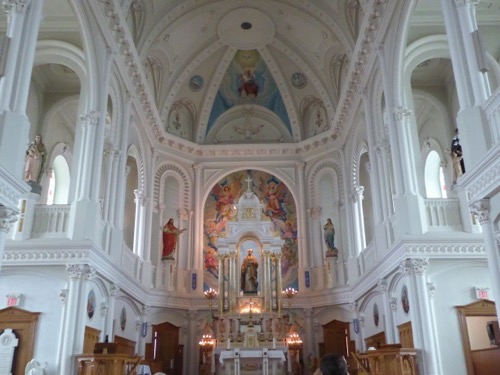
We stopped at St. Peters Church in Cheticamp.  It is 125 years old, will seat 2,000 people and has amazing acoustics that I got to demonstrate by singing ‘Amazing Grace’ solo. The 1904 Casavanti Brothers pipe organ is still in use today.P1040278

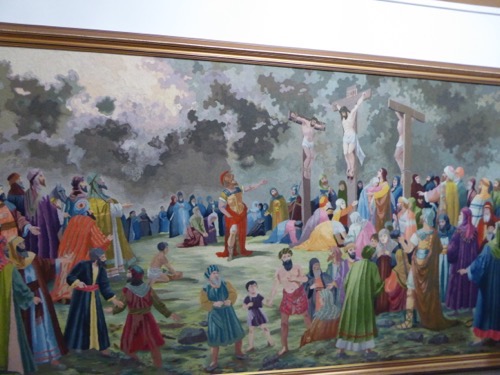
Our next stop was at Flo’s Hooked Rugs.  Inside was a museum called Les Trois Pigno (pronounced La Traw ee-on) and means The Three Gables. Marguerite Gallant donated the majority of the items in the museum and Elizabeth LeFort was the artist in hooked rugs and tapestry. She began hooking at the age of 15 and was still doing it two months before she died at the age of 91.P1040276P1040279

Her hooked pieces are works of art.  She has done pieces of many of the worlds important men like presidents and prime ministers, astronauts and sports players.  She has pieces hanging in the Vatican and White House and is know throughout the world for her intricate work all hooked with yarn that she died herself.  Some pieces have over 500 colors of yarn that she made herself.

Later in the day we had ice cream while wading in the Atlantic Ocean on Ingonish Beach. Today there was no wind and gentle swells of waves unlike two days ago.