We are staying in Tababela, a suburb of Quito, at Casa d'Campo Hotel Boutique. They have 4 cabins with 3 rooms in the main house where we will dine. It looks like an old home with modern amenities but is only 15 years old. In the US it would be labeled a bed and breakfast.
Showing posts with label Galapagos. Show all posts
Showing posts with label Galapagos. Show all posts
Friday, January 10, 2014
Travel Day to Quito
Fri. 1/10 - We left the boat at 8:30 this morning and walked thru a Galapagos Interpretive Center beforewalking around town and having lunch. The rest of the day was spent flying back to Quito.

Thursday, January 9, 2014
Santa Fe and Plaza Islands
Thurs. 1/9 - A short walk this morning on Santa Fe Island took us past Santa Fe land iguanas and many sea lions of all ages. Mocking birds are plentiful as are Galapagos hawks. We watched a couple of mother sea lions nursing their pups on the sandy shore while a big male chased off two coming-of-age males.


Back on the boat we prepped for snorkeling off the panga. We saw lots of fish, the sea lions rushed past and one sting ray escaped the cove shortly after we entered the water. I spotted an octopus but it disappeared before I could show it to John.
After lunch ( are you seeing a pattern?) we moved to South Plaza Island and took a late afternoon leisurely walk along both sides of this small narrow island. Sea lions, sparrow tailed gulls and iguanas populate this island while magnificent frigate birds and red beaked tropic birds soar overhead. While waiting for the panga to pick us up we watched baby sea lions frolic in the surf.
This is our last night on The La Pinta. It has been a most enjoyable week in paradise while learning many new things about nature and the world we live in. But I think we are ready to move on to our next adventure.
Wednesday, January 8, 2014
Post Office Bay and Sting Rays on Floreana Island
Wed. 1/8 - We got to sleep in this morning then we went for a short walk on Post Office Bay on Floreana Island. While there we stopped at the 'post office' barrel. Started by the whalers late in the 1800's one can place a letter or postcard in the barrel. When the next ship comes by the people check the barreI to see if any mail is addressed to someone near their home and then that person delivers the mail by hand. So we all addressed a postcard to ourselves or to a friendly family and put it in the barrel. Then other postcards were pulled out of the barrel and the cities called out. If you lived nearby you were asked to deliver that postcard. I got one for someone in St. Louis. When we get home I'll go see my mom and deliver the card. It will be interesting to see how long it takes for someone to deliver my card to me!


We then snorkeled from the beach. After lunch the shipp moved to Champian Inlet where we snorkeled from the panga. It was one of the best spots so far. Ka-jillion fish in blue, blue water!!
Our late afternoon walk at Punta Cormorant took us near flamingos and then to a white sand beach crawling with sea turtles and sting rays! It was a magical beach visit.
The lesson for the day concerned natural selection using Darwin's Finches. The research and conclusions were started by Darwin, continued by Lark, finished by Mr & Mrs Grant. The whole goal and mission of the park is to maintain these islands in as original state as when Darwin first visited here. Not always an easy task when rats on ships get on the island or humans kill all the turtles for food or pollute the area with trash or bring in seeds from non-native plants.
Tuesday, January 7, 2014
The Great Tortoises
Tues. 1/7 - We left ship at 8:30 this morning and spent the whole day on Santa Cruz Island in the town of Puerto Ayora. At the Darwin Research Center we learned how the eggs are taken from the tortoises and brought to the center to incubate and hatch. They are kept in enclosed pens for two years and then in open areas for another 5 years to learn how to live in the wild They are released on Santa Cruz Island or two other Islands to repopulate the archepelago with this very important link in the evolution of these islands.


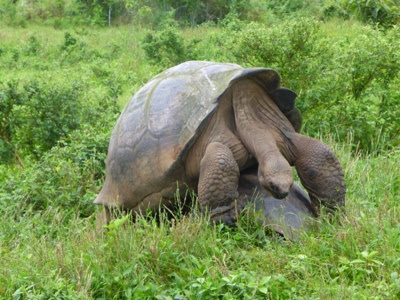

We shopped in town then a short boat ride to the Finch Bay Eco Hotel for lunch and a rest around their pool. Then we were off to see giant tortoises in their natural habitat. Just outside of town on a small ranch in the highlands there reside a large number of these giants. The females come here to be fertilized and then lay eggs near the shore but the males stay here all the time. We were allowed to walk near the tortoises to photograph them but could not touch them. One lone female was accosted by an amorous male while we watched. The sad part was that he mounted her from the wrong end!
This island is lush and green due to its location in the archepelago and was hot and humid even when it rained. This was in stark contrast to the dry, arid islands we have visited thus far. Santa Cruz was first populated by pirates and whalers but now is the home to native Galapagoans. Our guide is from here but now calls Quito home.
Monday, January 6, 2014
Rabida Island and Cerro Dragon
Mon. 1/6 - Last night we sat on the bow of the boat with our friends to watch the stars and moon shining on the water. Since we are on the equator we are not sure what constellations we are seeing.


As clear as the sky was last night it was that cloudy this morning! But as the day wore on, the sun came out and we had a very hot day. Rabida Island is a very small island with a bright red beach due to the abundance of iron in the rock. We took all of our snorkeling gear with us to the island but went on a hike until the day warmed up more.
Today's lesson was about the finches found on this island. Even though only one type of finch first came to the island, three distinct lines of finches have evolved with as many as 6 varieties in each line. Most of the differences focused on the size and shape of their beaks which are used in different ways to get their food.
Then we had the most amazing experience snorkling in the bay. The water was clear and smooth and the variety of fish and marine life was numerous!
As we lunched and napped, the boat moved to Santa Cruz Island and parked near Cerro Dragon (Dragon Hill). In a brackish lagoon we watched 6 pink flamingos scoop up mud and crustasions in their long beaks. Later we heard the cry of a baby goat and the bray of a donkey. Both are wild, feral animals on this island and currently are a controlled population.
Our days have taken on a routine with breakfast at 7:30, first morning activity at 8:30, second morning activity (usually aquatic), lunch then two seperate afternoon activities one of which might be aquatic or a talk or movie. There are three naturalists who take groups ashore for each activity. At 7:15 we attend a briefing for the next day then supper at 7:30. Breakfast and lunch are buffets and dinner is a choice of meat, fish or pasta. A couple of times during the day we are served snacks if we want one.
At the end of the day, we are tired and ready for early bedtime.
Sunday, January 5, 2014
Isabela island
Sun. 1/5 - During the night the ship cruised down Isabela Island to about its mid-point and stopped at Urbina Bay. This area was formed by an uplifting of land in 2008 caused possibly by a gas bubble under the surface and added 3-4 square kilometers of land to the island. This island was also home to thousand of goats which were brought here by sailors but then reproduced to over populate the island. A few years ago the park had them all killed or as many as they could find.


During our hike we spotted 3 giant tortoises. There are many islands where one can find these turtles but this spot is the only one on the tour where we will see them in the wild. The shells of some of these tortoises are shaped like a Spanish saddle, which is called Galapagos in Spanish. With a raised area over the tortoises neck, they can stretch out and up to reach flowers on tall cacti. Land iguanas also populated this island. Most of them were yellow in color due to the abundance of yellow flowers they eat. I noticed many holes in the ground which were burrows for the iguanas. We were told that the males dig tunnels between several burrows which attracks the females. Evidently the females like a man with lots of property!
Following a talk about the differnt fishes one can find around these islands we went snorkling in Tagus Cove then hiked up the back of Darwin Crater. The crater is filled with salt water with about 30% salt so nothing lives in it. Right now the landscape is very brown and dry since most of the trees are lying dormant until the rainy season begins which should be soon.
Saturday, January 4, 2014
Punta Vicente Roca & Punta Espinoza
Sat. 1/4 - For our first full day we visited the islands of Isabela and Fernandina where we stopped at Punta Vicente Roca and Punta Espinoza. Isabela is long and skinny with an outcrop that makes it look like a seahorse. After breakfast we boarded a Zodiac for a ride along the coast of Isabela with a geography lesson on how the volcanos shapped these islands. A cave on the water was once a lava tube. Most of the islands were formed by volcanos that sprung up non-violently but this particular volcano exploded outward to form the 'nose' of Isabela.


This is the only place in the world where one will find marine iguanas who are dependent on the ocean for their food. The males will actually dive under the water for food while the females and young will feed at waters edge. This is their breading season so the males were very colorful and actively protecting their territory so they were facinating to watch. We also watched the flightless cormorants hop around on the rocks. Once a flying bird they now have very small wings that are used for balance only but they still dive in the ocean for fish. One of the rarest sights on the islands is the Galapagos penguin. Only about 2000 live here and it is the warmest place you will ever see any penguins.
Following the boat ride we prepared to go snorkling in the same waters we explored above the water line. Besides all the colorful fish we were startled by a sea lion and enjoyed floating with the sea turtles. This is one of our favorite activities and one we will get to do everyday on this trip.
Following lunch we watched a movie about the Galapagos then the pangas took us to shore n Fernandina Island where we walked on ancient lava fields and witnessed the transformation of the volcanic rock into mango groves where many birds live and where iguanas and sea lions find shade and shelter.
Speaking of iguanas, Fernandina Island has one of the largest populations of marine iguanas on any of the islands. So many, in fact, that we had to watch every step so that we wouldn't step on any. We also got to watch them swim and fight over the females. We saw the Galapagos hawk, the Galapagos mockingbird, a yellow warbler, sea lions, and one penguin. And did I mention we saw hundreds of the iguanas?
Friday, January 3, 2014
Galapagos Here We Come
Our guide picked us up at 6 am to take us to the airport. We flew to Guayaquil then to Baltra Island in the Galapagos. From the airport we boarded a bus to the pier then a panga (small boat) to La Pinta Motor Yacht. We dropped our carry on bags in our room, ate lunch, took a short nap then back onto the panga (zodiac boat) for a guided walk on North Seymour Island with our naturalist, Carlos.
John stayed on the ship trying to get better. The rest of us experienced our first encounter with the animals of the archipelagoes. Sea lions, red crabs, land iguanas, frigate birds, sparrow tail gulls, brown pelican, blue-footed boobie birds, more sea lions, more frigate birds of all ages and crashing waves. We were all so excited to walk right next to any one of these creatures. I probably took way too many photos. Here are the best:


Tuesday, December 31, 2013
South American Adventure Begins
We want to give you a heads up about our upcoming adventure. We leave for Quito, Ecuador on New Years Day and will be traveling in South America until February 7th, and no, not in our RV. The adventure will take us from Ecuador to the Galapagos Islands, then Santiago, Chile and nearby wine regions. Next the southern tip of Chile where we will hike in the Torres Del Paine National Park of Patagonia. After that the Mendoza, Argentina wine region and lastly Buenos Aires, Argentina. We are traveling with some very good friends, John & Susanna and Jack & Mary. As we have been planning this trip for over 9 months, to say we are excited is an understatement.
I have every intentions of blogging daily but the issue of internet access may make that difficult to impossible. Be patient.
We wish you all the best of the New Year in 2014!!
Subscribe to:
Posts (Atom)