Showing posts with label Canada Nova Scotia. Show all posts

Tuesday, August 28, 2018

Made in Nova Scotia

Since it was a relatively short drive to Truro today, we stopped in Stellarton to visit the Museum of Industry in Nova Scotia. The displays started with the use of water power and worked up to steam power, locomotives, model trains, iron and steel and automobiles.  Then we learned about making glass, sawmills and electric power.  P1040549P1040551

Coal mining was a huge industry in this area.  The exhibits on mining were well done but the cost of life in the mines was very high due to explosions and cave-ins. Even so, the men seemed to love their work and were upset when the mines had to close.  Altogether a very interesting display.

The trip is winding down with only a couple more stops before we have to say goodbye.

Monday, August 27, 2018

Fortress of Louisbourg

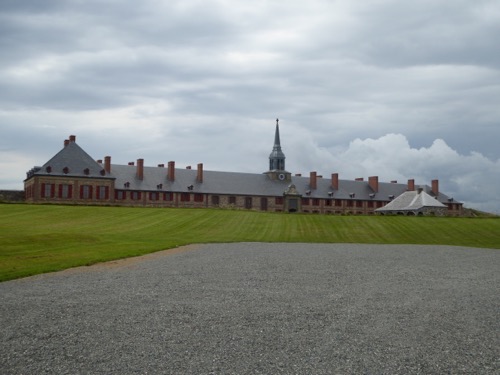
P1040521P1040522This afternoon we toured the Fortress of Louisbourg National Historic Site.  The French came here in 1713 after ceding Newfoundland to the British.  This site was situated such that it would be useful in protecting PEI and Cape Breton from invaders as this was a rich area for cod fishing on the Grand Banks.  Louisburg became a hub of commerce and trading with France, Quebec, and New England. They had just finished building the last houses in 1745 when England again attacked and won the city. It was given back to the French in 1748 but the British won it back again in 1758 when they destroyed the fortress walls so it could never again be a fortified French base.P1040524

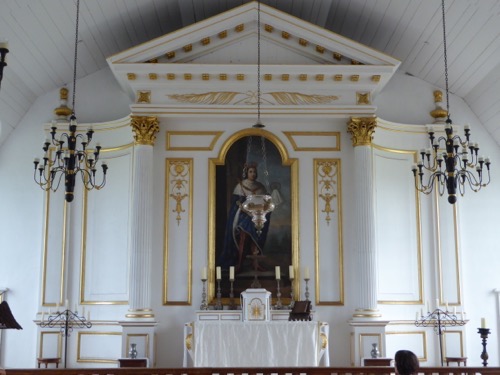
In 1961 the Canadian government began a $25 million project to rebuild the city on it original foundations.  To date only 1/5th of the city has been completed. The most prominent building is the King’s Bastion Barracks, Governor’s Apartments, Military chapel and guard house surrounded by a rock and dirt wall.P1040532P1040535P1040540
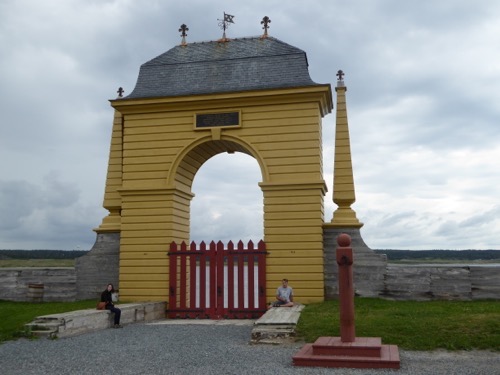
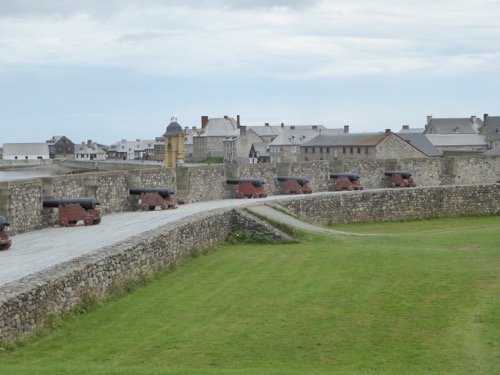
Other buildings include rich man’s residence and servants homes, storehouses, barns, shops, cafe, hotel or inn, stables and theatre.  The town was built right along the sea so there are several gates where wharves were located and a demi-bastion with cannons.  P1040525P1040526

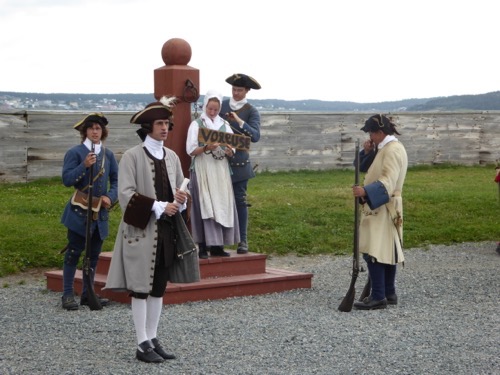
Shortly after our arrival a mob had gathered to see that a young lady who had stolen some items from her boss was publicly humiliated by forcing her to stand at a post with an iron collar around her neck for two hours a day.  She didn’t seem very concerned!  The costumed residents explained about life in the 1700’s, made bread, forged iron, danced, sewed, made lace and worked gardens.  We even experienced the shooting of a cannon and rifles.P1040541P1040547

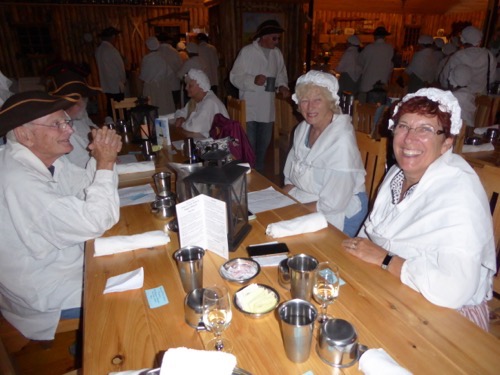
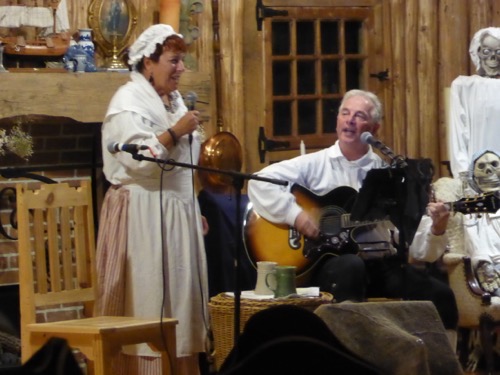
Following our tour we enjoyed a fun evening dressed as beggars and dining on snow crab and lobster while being entertained by musicians and a lady of the evening.  I even got to sing in front of the crowd! It was a very lively evening!

Saturday, August 4, 2018

A Repeat Cabot Trail

Today the Adventure Caravans chartered a bus to take us around the Cabot Trail, again. We went the opposite direction from the other day so we got a different perspective of views but we also made a few stops that we skipped the first time and gained some knowledge of the area from our guide. The four main industries are fishing for lobster (in May and June only) and snow crab (until you reach your limit), farming, forestry and tourism. There used to be 12 coal mines and a steel mill but those are all closed now.  The Cape Breton population is about 130,000 and most speak French/Acadian and some Gaelic  so signage is in English and one of the other two languages.P1040271P1040267P1040269

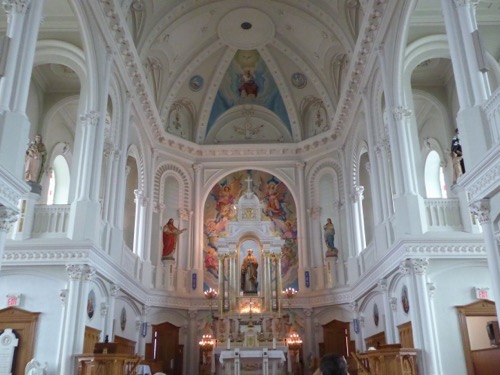
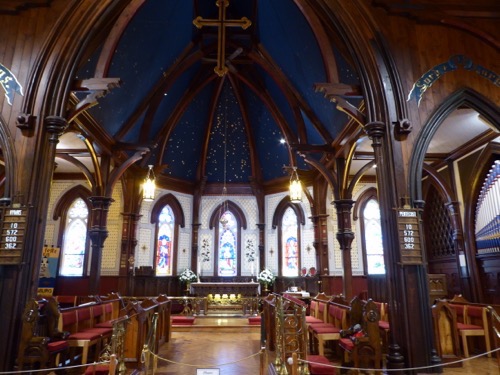
We stopped at St. Peters Church in Cheticamp.  It is 125 years old, will seat 2,000 people and has amazing acoustics that I got to demonstrate by singing ‘Amazing Grace’ solo. The 1904 Casavanti Brothers pipe organ is still in use today.P1040278

Our next stop was at Flo’s Hooked Rugs.  Inside was a museum called Les Trois Pigno (pronounced La Traw ee-on) and means The Three Gables. Marguerite Gallant donated the majority of the items in the museum and Elizabeth LeFort was the artist in hooked rugs and tapestry. She began hooking at the age of 15 and was still doing it two months before she died at the age of 91.P1040276P1040279

Her hooked pieces are works of art.  She has done pieces of many of the worlds important men like presidents and prime ministers, astronauts and sports players.  She has pieces hanging in the Vatican and White House and is know throughout the world for her intricate work all hooked with yarn that she died herself.  Some pieces have over 500 colors of yarn that she made herself.

Later in the day we had ice cream while wading in the Atlantic Ocean on Ingonish Beach. Today there was no wind and gentle swells of waves unlike two days ago.

Friday, August 3, 2018

Alexander Graham Bell

We drove to Baddeck (pronounced Ba-deck) today to tour the Alexander Graham Bell National Historic Site and Museum.  Bell met and married his wife, Mabel, while teaching at a deaf school.  Mabel was going deaf and was his student at the school. It was this that led him to invent the telephone at the age of 29 but his inventions did not stop there.  He had a fascination with flight and invented the Silver Dart which was the first controlled, powered flight in Canada.P1040263

He also saw a potential for speed on the water and created the HD-4 hydrofoil that broke a marine speed record.  Baddeck was his second home and where most of his discoveries were made and the work was done.P1040265

We enjoyed a short walk through town and had lunch on the deck of the Baddeck Yacht Club, dining on food from a food truck named ‘Stand and Stuff Your Face’!

Tonight we went into Sydney for a Surf and Turf dinner as a farewell to five couples who are heading back to the US on Sunday and we welcomed a couple who will travel with us the remainder of our trip. The five who are leaving are going for various reasons such as family obligations or not wanting to leave pets in a kennel or on their RV during the overnight ferry ride or just need to get home to see the grandkids.  We will miss these folks and wish them a safe journey.

Thursday, August 2, 2018

Arm of Gold

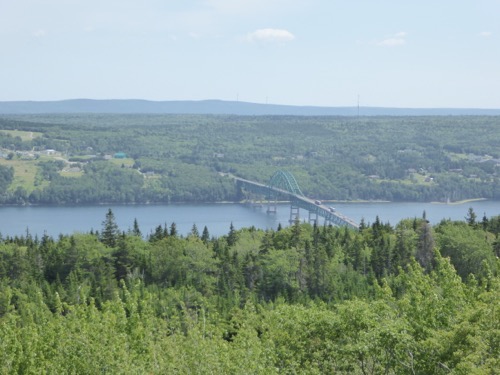
Wednesday  was a travel day from Halifax, back to Truro and then north up towards New Glasglow, across the Canso Causeway that connects the Nova Scotia islands, and into North Sydney and the Arm of Gold Campground.  The Canso Causeway is the deepest causeway in the world at 217 feet deep.  It is 90 feet across on top and 800 feet wide at the bottom with a bridge that swings around to allow boat traffic to pass through.  The road to North Sydney travels along the Bras d’Or (pronounced Bruh-door) Lake which is actually an inland sea fed by the Atlantic Ocean. We found out later that Bras d’Or is French for Arm of Gold.
P1040246

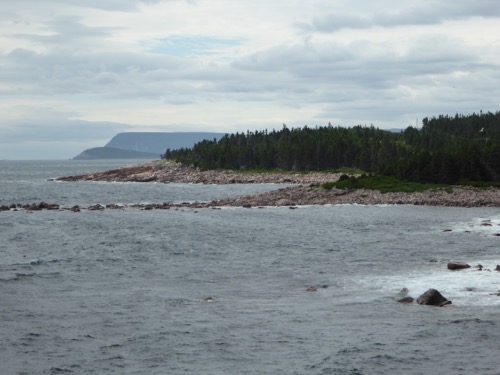
Today we decided we wanted to explore the Cabot Trail and the Cape Breton Highlands National Park instead of what was planned for the caravan.  The Cabot Trail is a 185 mile loop around the peninsula with stunning views of the Atlantic coast and the Gulf of St. Lawrence coast with mountains inland.  P1040250P1040248P1040252

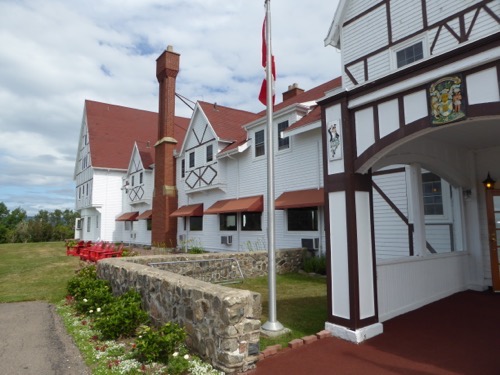
We hiked three of the 26 trails in the National Park.  The Middle Head trail started at the Keltic Lodge and was about 2.5 miles with views of the Atlantic Ocean, the MacIntosh Brook was a 1.2 mile loop in a quiet forest up to a lovely little waterfall, and the Skyline trail was on the opposite side of the peninsula from the Middle Head trail so we had a clear view of the Gulf of St. Lawrence on a 5.1 mile long trail in what seemed like gale force winds!P1040253P1040255P1040261

We had lunch at a quaint cafe that served wonderful crab cakes in a screen room full of antique bric-a-brac and dinner at the Harbor Restaurant in Cheticamp. It was a long but beautiful day.

Tuesday, July 31, 2018

Rails to Trails Bike Ride

IMG 6949A bike ride on a relatively flat grade is always inviting, so riding on a rails-to-trail path along a beautiful river and lake is that much more inviting. Not far from the campground is the St. Margaret Bay Trail for walkers, bikers and ATVs and at 20 miles round trip it was just what we were looking for.  Mellow and Janet, with their electric assisted bikes were happy to join us.  It was a lovely ride that seemed to be up hill both ways but we had breaks along the way and a nice lunch at the end.  The lake was actually St. Margarets Bay which is where Peggy’s Cove is located but the trail didn’t go that far out.

IMG 6950

The rest of the day was spent showering, getting hair cuts and resting from the ride. 

Monday, July 30, 2018

Halifax Harbor

The bus dropped us off at the Maritime Museum of the Atlantic and then we were on our own to explore or shop or eat until around 2 PM.  The museum was interesting as they had lots of models of all sorts of ships from the early 1700’s to modern cruise ships.  We learned more about the Explosion of 1917, and more about naval history than we really wanted to know.P1040233P1040234
P1040238

The board walk along the waterfront was busy with lots of shops, tour companies, and restaurants.  It was nice to get out and stretch our legs in warm sunshine.  We had a nice lunch at the Bicycle Thief then met the caravan for the highlight of my day - a ride on the Tall Ship Silva under full sail!  Its a large 3 mast, 5 sails ship made of iron with a wood deck with seating for about 100 people. Some of the men and young boys got to help raise the sails but for safety reasons they still had the engines running the whole time.  But it was so awesome!P1040240P1040244

Then, the highlight of John’s day, we had a fun brewery tour and tasting at Alexander Keith’s Brewery.  They have been around for over 150 years and had some of the best beer we have tasted.  According to the brewery the best way to experience their beer is with friends and music.  The friends we had with us and the music was provided by the brewery.  Good Irish tunes and a song from a  Newfoundland group I have read about called The Great Big Sea. So much fun and laughter!

Sunday, July 29, 2018

Halifax and Peggy's Cove

Caroline is a retired social studies teacher and has tons of dates memorized and ready to expound upon as our guide to Halifax. Most of the dates we had heard about from our other historical tours so I won’t go into them again.  Halifax was settled in 1749 and was used by the British to protect the lower colonies from the French.  At that time we were still under British rule.P1040199

Just a little bit of trivia about this region. Halifax has the second largest & deepest ice free harbor in the world (Sydney, Australia is #1).  Nova Scotia mean New Scotland but was settled mainly by Dutch and Germans (Deutsch sounds like Dutch but means German) but there are a lot of Irish and Scotch influences. Lobster season runs from Nov. to May in this area. Average winter temperature is zero so if colder it snows and if warmer it rains, sleets then snows.

On our way to Peggy’s Cove we stopped at Canadian Maple Products and learned all about Maple syrup. 98% of maple sap is water, 85% of the world’s maple syrup comes from the Maritime Provinces. A maple tree is 50-75 years old before you can tap it for syrup but it can be tapped every year for up to 100 years and in Nova Scotia only 10% of the trees are tapped - that can be 20,000 trees in 118 acres or 150,000 trees somewhere else or 5,000 in your back yard. Forty gallons of sap will make 1 gallon of syrup. And of course I bought lots of syrup, maple candy and maple butter.P1040204IMG 6900

South of Halifax is an area along the Atlantic coast with numerous small bays like Terrance Bay,  Shedd Bay and St. Margaret’s Bay where the tiny town of Peggy’s Cove is located.  This used to be a fishing cove but is recognized today as an artist’s community and draws thousands of tourist every day. The story goes, in some form or another, that Peggy was the lone survivor of a shipwreck at this small cove before 1811. Bill Degarthe was the artist in residence and carved out a rock wall to depict the life of a fisherman who is in communion with God and protected by His angels.P1040212IMG 6902

We had a lovely walk about town, stuck our heads in a couple of shops then had lunch.  The rocks surrounding the lighthouse have been worn smooth by the ocean waves and make a beautiful landscape and a fun place to climb.  It was foggy all morning, seemed to lift at lunch time but it dropped back down before we could see the opposite shore.  We did get some pretty pictures though.P1040214P1040215

It seems as if Halifax has seen it share of tragedy. We drove past the area where Swiss Air 111 crashed into the ocean killing all on board.  Then we stopped at the Fairview Lawn Cemetery where victims of the Titanic are buried.  The dead were brought to Halifax, some were buried at sea, some in their religious cemeteries (if known) and the majority were buried in Halifax. Some were identified but many were unknown. P1040218

Then on Dec. 6, 1917 at the beginning of WWI, a French ammo ship, the Mont Blanc, was coming into Halifax harbor to lay over before going to Europe.  As it was passing through the narrowest point in the harbor another ship, the Imo full of medical supplies for the war, was coming out.  The ammo ship clipped the other ship causing a gas spill on the ammo ship.  As they pulled apart, sparks ignited the gas and 30 minutes later the largest man made explosion in the world blew a hole in the harbor and destroyed 2 km of the northern part of the city of Halifax, killing almost 2,000 people and injuring another 1,000.  To this day this was the largest non-nuclear explosion in the world.  The Mont Blanc was carrying almost 3000 tons of explosives.P1040221P1040222

Now on to more pleasant sights.  We enjoyed a band playing blues music while we walked through The Public Gardens laid out as a Victorian style garden with exotic plants and lovely designs made of flowers.P1040228P1040230

Our last stop was the Halifax Citadel where we watched the changing of the guard and walked the ramparts before going into the museum. This fort sits high on a hill overlooking the city and harbor.

Saturday, July 28, 2018

Dartmouth

Saturday was a short travel day with a 60 mi. drive up the coast to the RV park on the outskirts of Halifax.  And the campground wanted us all in our sites by noon.  Once we got settled in, Mellow and Janet invited us to join them in going to Dartmouth.P1040197

This used to be a separate city from Halifax but once they built two bridges to connect the cities, it became one city but retained its name of Dartmouth. We crossed one bridge then enjoyed the waterfront area as they were celebrating the many cultures found in the city.  We listened to some music, wondered through a shopping tent then enjoyed the many wonderful aromas coming from the food tent.  There were foods from Jamaica, Africa, India, Nova Scotia, and several other nations. We then found our way back over the second bridge in time to share a dinner with the caravan.  Good fried chicken, salads, and watermelon.

Friday, July 27, 2018

Lunenburg Fisheries Museum

The oceans around the Maritime Provinces used to be teaming with cod.  The continental shelf is the widest of any continent and has shallow water (if you call 200-250 ft. shallow) but it makes for a good fishing area.  The Grand Banks of Newfoundland have some of the best fishing.  Cod is not as plentiful these days as it was in the early part of the 1900’s but they are working to bring those number back up.
P1040187P1040180

Three currents make this area great for fishing.  The Labrador current brings cold water plankton down from the north, it mixes with the warm currents from the St. Lawrence river and the Gulf Stream in the Atlantic sweeps all the way up her bringing more food and fish.P1040184P1040188

Line fishing was the preferred method to catch cod in 1938.  Lines up to 2 miles long filled with hooks would be dropped into the water with weights to pull them to the bottom then 3-4 times a day the dories of fishermen would go out, haul them up, remove the fish, rebait and drop it down again in some of the most horrible, cold conditions you can imagine.  In 1962 the schooners were put ashore and steam ships with iron hulls and nets became the way to fish.

Because cod is not so plentiful, lobster and scallops is the industry today with cod imported from those who fish beyond the international waters.  

Sable Island is a large sand bar off shore from Nova Scotia.  It is called the Graveyard of the Atlantic due to the hundreds of ships hitting the sand and sinking. The winds on Sable are 18 mph or more all the time, the island is low and before technology ships could loose their way or be pushed by storms into the reefs. In 1927 over 12 ships were sunk in August of that year.P1040189P1040192

We enjoyed walking around Lunenburg, visiting a church that burned in 2001 and has been reconstructed to look exactly like it did before the fire.  We also drove over to Mahone, another cute little harbor village.