Showing posts with label Canada Newfoundland. Show all posts

Sunday, August 26, 2018

Grand Codroy to Port-aux-Basque

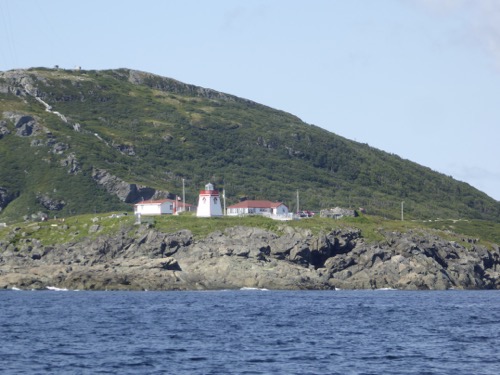
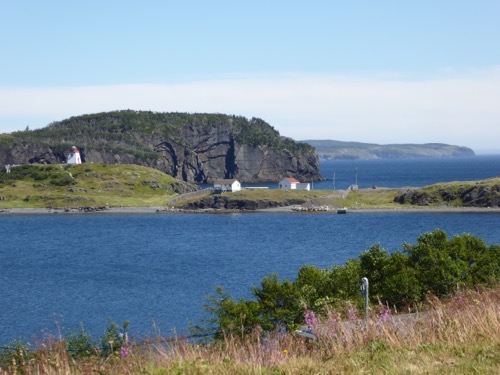
P1040520We caught up with the rest of the caravan on Saturday in Grand Codroy just in time to enjoy a pot luck dinner and games.  We did have a short time to explore the area and had a nice drive around the bay and out to the Cape Anguille Lightstation, the most western lighthouse in Newfoundland.  We almost stopped at a tiny little truck for a local hamburger but I talked John out of it.

Sunday we bid a fond farewell to Newfoundland as we boarded the ferry for the short six-hour ride back to North Sydney to stay at the Arm-of-Gold Campground again. We are so disappointed that we only glimpsed one moose about a week ago and saw no others.  We did see a lynx and that was special. 

Friday, August 24, 2018

Table Lands and Baker's Brook Falls

It was raining so yesterday was a good day to stay in and do nothing or just catch up on ‘stuff’ like paying bills and writing blogs.  We did get out to take a short hike on the path to Gros Morne Mountain.  We allowed ourselves an hour so we turned around just short of the base of the mountain where it would start getting steep.  It was a good thing we did as the mountain top was covered in clouds. But it was a quiet walk through rain forest full of ferns, moss and mushrooms.  But no moose.P1040516

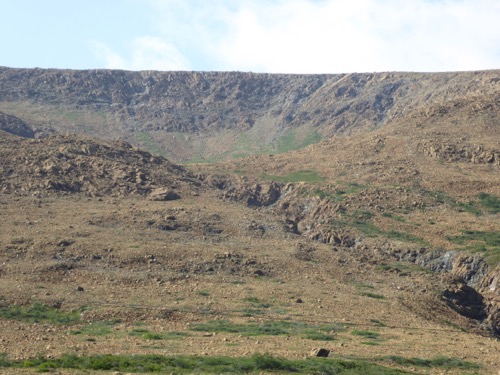
Today we drove about an hour around the East Arm and the South Arm to take a hike on the Earth’s mantle.  Our park ranger guide taught us (or tried to teach us) about the geology that caused the earth’s crust to split apart, the tectonic plates shifted and then forced some of the inner materials to squeeze out on top of the crust. It has only happened in about 3-4 places in the world. The mantle is so acidic and dense that nothing will grow here and its been around for millions of years like this.  What plant life we see is due to human intervention.  

Before the hike on the mantle we did explore the town of Trout River and the actual Trout River itself.  One couple from the caravan, David and Betty,  took a zodiac boat ride up the river and then walked back with a ranger.  They said it was beautiful and informative. P1040517

We tried to hike on the Lookout Trail to get a view of the Arms and the Gulf of St. Lawrence but it was closed so we drove back to Rocky Harbor and hiked the Baker’s Brook Falls Trail which turned out to be the most uninspired walk we have taken in a long while.  I would guess that 90% of the trail was a board walk through low-lying marsh and bog.  At the end of the trail was a spectacular waterfall that made the boring walk worthwhile.  The waterfalls and the 6 miles of walking were good but still no moose.

As a reward for all those steps we had a delightful and delicious dinner with Janet and Mellow at the Black Spruce.  We would highly recommend it.

Wednesday, August 22, 2018

More Hikes in Gros Morne

Gros Morne means Big Small Rounded Mountain but can also mean Big Isolated Hill or Big Gloomy, Dismal Hill and all would be correct depending on the weather.IMG 7254

The first and second hikes were with Mellow & Janet and David & Betty.  The first was only about 1/2 mile long but it took us to the top of Berry Hill.  This hike lived up to its name as we picked wild raspberries and saw blueberry plants and crow/ghost/bunch berries.  The second hike was around Berry Head Pond. Pond is another word for Lake in Newfoundland.  This was only about a mile but we enjoyed stopping to look at moss, lichen, mushrooms, flowers, berries and trees.  We also found a beaver lodge but no beavers.P1040513IMG 7257

After a picnic lunch we drove over to Lobster Cove Head Lighthouse which had several short paths to some scenic overlooks.  Then John and I found the Coastal Trail with cobble beaches and tuckamore forests.  These are evergreen trees that are stunted by the wind and snow and bunched together so tightly one cannot get through them. A light mist sent us back to the car.

We drove through Rocky Harbor then out to Norris Point researching good dining establishments.  We found one for dinner then we joined the caravan at a pub for the Anchors Aweigh show.  It was a rollicking, funny Newfoundland band playing folk songs and jigs.   We tapped toes, laughed and danced a jig for a very fun evening.

Tuesday, August 21, 2018

Gros Morne National Park

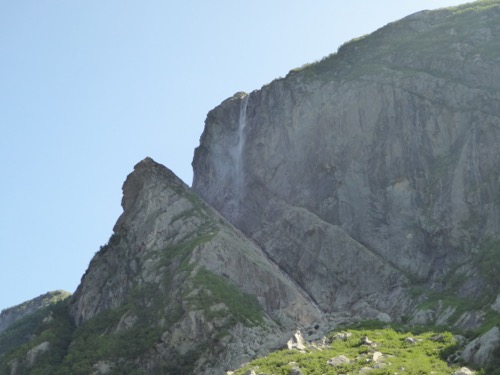
We left at least an hour earlier than most of the others in our group so we could stop at Western Brook Pond to take a boat ride.  Actually, we had to hike 3 km to reach the boat dock.  The Pond is really a huge lake that was created by the retreat of glaciers 15,000 years ago.  At one time it was a fiord but as the ice moved away, the land heaved a sigh of relief and rose up, cutting off access to the ocean.  The lake is so deep (over 160 meters) that it takes 15 years for it to refresh itself.  And because of that it has very little vegetation or fish and is crystal clear.  The two hour boat ride took us 16 km to the very end past high 650 meter tall cliffs, long waterfalls, and rock slides. One water fall was named Pissing Mare.  I think I would have named it something nicer like Bridal Veil!P1040501P1040508P1040493P1040510

Three kilometer hike back, find the RV park and then we had dinner with Janet and Mellow.  David and Betty joined us later so we could plan our adventures for the next three days.  The caravan will leave on Thursday but the three couples will stay an extra day to enjoy more of the park.

Gros Morne is a UNESCO World Heritage Site due to its geology.  We hope to hike on the Earth’s Crust which was pushed into place when the continents collided billions of years ago then shaped by the glaciers 15,000 years ago.

Monday, August 20, 2018

Discovering the Vikings' Visit

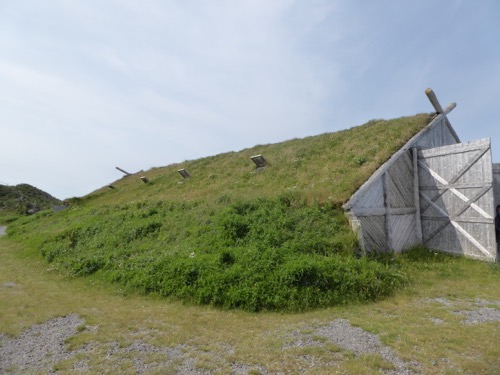
Over 1,000 years ago, Leif Eriksson left Greenland and sailed west where he landed on the northern peninsula  of Newfoundland.  There he set up a base camp from which they could explore the area further south, some feel as far south as New Brunswick looking for hardwood, furs and grapes for wine. They built turf walled buildings that served as over-wintering quarters with houses for all the crew, a forge, storage for supplies, rooms for women and servants.  They used this site for perhaps 20 years but burned it down and went back to Greenland when they couldn’t afford the expense of this settlement.  Fast forward to 1960 when interest was high in discovering if the Vikings arrived before Columbus. An archeologist had read the sagas and knew there had to be a settlement site somewhere on North America. When he visited NF he talked with a local fisherman who told him about the Indian ruins.  A short time later he found some small artifacts that proved the Norse had lived here. We call them Vikings but that term applies to Norsemen on a raiding expedition.P1040451

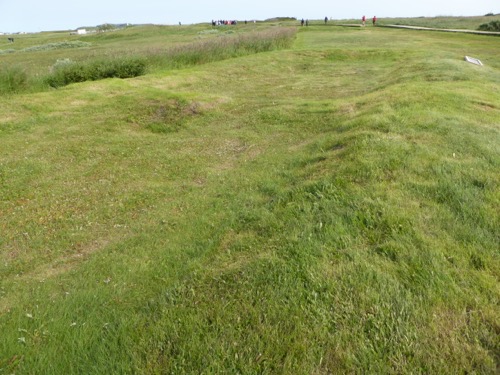
L’Anse aux Meadows National Historic Site is the name given this settlement and it means Point of Meadows. It was designated the first cultural UNESCO World Heritage Site.  The actual locations of the original buildings have been marked off and preserved by allowing them to be overgrown but they have built exact replicas so that visitors can get a good idea of what life would have been like in the 9th Century.P1040455P1040459P1040462

The large hall would have housed the crew and dining hall.  Other houses were for the more important crew members, a hut for servants, and a hut for the women to work on weaving and living quarters.  Another large hall was for the commander, Leif, and his command personal and held a banquet room and storage for supplies and boat repair.  There was also a smelting hut where they extracted iron ore from the bog ore but only enough for 200 nails.P1040466P1040471P1040472P1040473P1040477

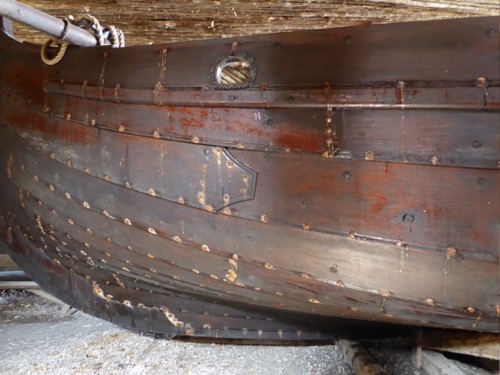
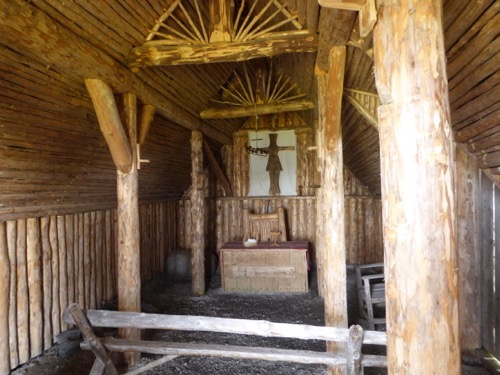
Our next stop was another reconstructed Viking Village.  This was a commercial site and included an authentic church and Norse boat showing the details of where iron nails would have been used, the size of the mast and sail and the tonnage of the ship.  Including ballast, cargo, crew and crew supplies the ship would have weighed over 35,000 tons and still sat high in the water.

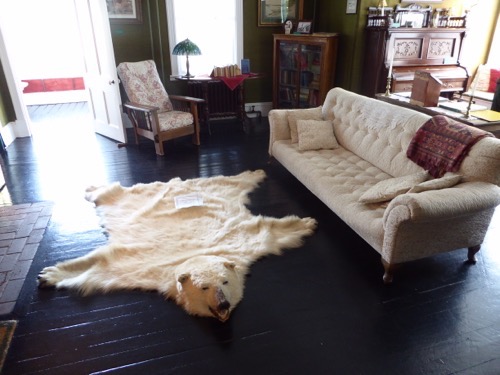
During the afternoon we learned about a very important Newfoundland Labrador doctor who came here in 1892.  Sir Wilfred T. Grenfell couldn’t believe the poverty and diseases the people of the North Peninsula endured.  They were sick with TB, scurry, beriberi and malnourished as well as living with inadequate clothes and housing.  He went home to England, gathered supplies and funds and came back to help these people.  His first hospital ship treated over 900 people in three months time. He eventually moved here, married, had three children and was the driving force to build hospitals, schools, orphanages, nursing associations and training centers.  He also showed the people how to help themselves by creating crafting enterprises where they could make and sell their crafts.  He also helped the fishermen to unite and get rid of the fish mongers who were robbing the people of their income.P1040482P1040486
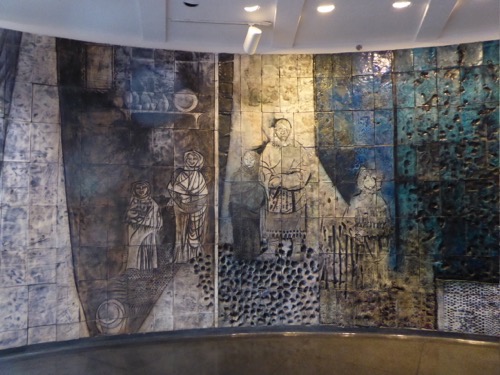
Mr. Grenfell’s home is a living museum and a mural in honor of the Grenfell Foundation is installed in the entrance of the local hospital.  The mural is made of ceramic tile and surrounds the rotund reception area.  It was created by Jordi Bonet.

To end the day we enjoyed a Viking Feast with local foods such as brewis, moose stew and salted beef.  

Sunday, August 19, 2018

Whale Hunting

P1040447Most signs state “Whale Watching Tour” but our naturalist insisted it is more of a “whale hunting tour” as they cannot determine exactly where the whales are running although they have a pretty good idea as they have spotters on the points and in the ocean as well as all the passengers on the boat. P1040431P1040439P1040442

During our 2.5 hour ride we spotted at least three Fin Whales and several pods of Atlantic White Beak Dolphins, four puffins floating on the water and numerous gannets and murres flying overhead.  Fin Whales are among the largest whales on earth reaching up to 60 feet long which was almost twice the length of the boat we were on.  They would surface 3-4 times then on the last time they would bring their whole body above the water line and then dive for up to 15 minutes before coming back up again.  One Fin Whale was on a mission and actually left a wake as he swam past us.  Some of the dolphins swam with the boat and one pod of dolphins were in a mood to jump out of the water and splash back down (called breaching) many times in a row.  That was very fun to watch.P1040427

Look close you can see the wooden steps.P1040448IMG 7211

This afternoon we tackled the Dare Devil Trail near the Fox Point Lighthouse. Over 475 wooden steps climb up 500 feet to the top of the cliff.  Once we caught our breath we walked along the ridge top enjoying the view of the Atlantic and one of the coves we cruised in this morning.

Today is our 46th anniversary so we went to dinner in Straitsview (or it might have been St. Lunaire or Quirpon or possibly Griquet - they all run together) where we dined on snow crab and scallops.  A few of the diners got excited about something out side so we looked also and there was a lynx walking on the lawn.  He was very curious but didn’t stick around very long.  What a beautiful creature!  

We drove on down the road a ways to check out the village and decided to stop at Skipper Hot’s Lounge for a night cap.  A live 3-man band was playing Newfoundland tunes (the rhythm guy was playing the ugly stick) while a few ladies danced jigs. Such a neat experience!

Saturday, August 18, 2018

Where is That Squeak?!

Since we have such a short drive up the coast to St. Anthony, we took our time getting ready to depart St. Barbe. Along the way a very annoying squeak in the RV door drove us to distraction.  We’ve been battling this noise this whole trip and have "had it up to here" with it.  John has tried making the door fit looser, fit tighter, added cushions, taken the cushions off, and I have pushed and pulled on the handle trying to figure out what is causing this squeak!  We stopped along the route at least three times and we still don’t know what is causing it to squeak!P1040440We spent the afternoon driving around the town, shopping in gift shops and a hardware store/housewares store, and exploring the docks and neighborhoods.  Its a pretty town which we’ll learn more about in another day or two.

Thursday, August 16, 2018

Travel Days

We pulled out of Twillingate on Wednesday, the 15th and drove to the base of the Northern Peninsula where we camped at the Jackladder RV Park on Bonne Bay Big Pond.  It was a beautiful evening.  Then in rained all night and part of the morning.  IMG 7176

Before we started off to St. Barbe near the point of the peninsula we stopped in the Newfoundland Insectarium and Butterfly Pavilion where we walked among fluttering butterflies from Costa Rica but not really as the weather was too cool for them and they mostly just sat on the leaves and limbs looking pretty.  We also learned about the life cycle of honey bees and perused the many display cases of beetles, bugs, moths and spiders. They had an impressive number of walking sticks, some tarantulas and a cool looking millepede.  

The rest of the day was spent driving along the coast of the Gulf of St. Lawrence enjoying the fishing villages and watching for moose, which we spotted only one and that was at a distance and driving 45 mph. The farther we get away from the main population center on the east coast of the island, the worse the roads get. It’s a full time job for John trying to miss the potholes and dips in the road.  It is still rainy and very cool.  

Tuesday, August 14, 2018

French Beach to Spillers Cove

IMG 7159We’ve had enough of museums and needed to get some exercise so we hiked out on the point at the end of Durrell Street.  Newfoundland has a very rugged coastline so it was a bit of a challenge to climb up the cliffs and walk along the top but it was worth the effort. The views were stunning.  We couldn’t believe how calm the waters were today. Yesterday the wind nearly knocked us over and today it was very quiet. Our hike was about 5 miles long.  IMG 7160

This evening we attended The Split Peas production.  These are 6-12 retired ladies who all sing, some play guitar or accordion but it is all close harmony.  At the intermission we got to eat Touton with molasses or jam and drink hot tea.  Touton is bread dough that is fried instead of baked. They got us up dancing, singing along with some songs and playing the Ugly Stick.  It was a fun evening.

Monday, August 13, 2018

Twillingate

P1040405Prime Berth Fishing Museum was nothing like what I thought it would be.  Dave, a Newfoundlander fisherman who still fishes, took us down to his dock and demonstrated how to cut a cod.  Once it is slit down the middle he removes the liver and puts it in a bucket to rot (that is how you get cod liver oil), then he disposed of the rest of the innards through a hole in the floor. Next you cut off the head, remove its tongue and cheeks to eat and something hard from the head that can be used to tell the age of the cod. Next you slice off the spine and feed it to the fish.  This causes the cod to be flat so you can filet the meat from the skin before dumping a large handful of rock salt all over it.  It is then placed on drying racks before being put in a barrel and sold. Or at least that’s how it was done for 100s of years. Now the fisherman just guts the fish in the boat and the cod is shipped whole and sold to a processor.IMG 7147P1040404

Dave had at least 4 other buildings with antiques from top to bottom, two full sets of whale bones and a gift shop. The whales had died before he got them so he dragged one out to an uninhabited island and let it rot for 3 years before cleaning off the blubber and putting the bones all back together.P1040407

In the afternoon we visited another museum, learned about polar bears which sometimes show up on the island, and then did a wine tour and tasting at Auk Island Winery.  Don’t get too excited, this was a fermented beverage made from wild berries, rhubarb, and strawberries. It was way too sweet for our taste.

The evening was spent at Twillingate NWI Dinner Theatre for food, laughter and music.  

Sunday, August 12, 2018

9/11 Reminder

On our way to Twillingate we stopped at the North Atlantic Aviation Museum located in Gander.  When the era of flight got better and flights got longer, this city became an important stop over for refueling before heading across the Atlantic.  Towards the end of WWI more airplanes were being used to fight the war then during WWII they became even more essential.  Over 10,000 planes were ferried across the ocean from Gander to Ireland or England.  When commercial flights started they would stop in Gander to refuel but as the planes got faster and jet engines became predominant the need to the stop over became unnecessary.P1040386

The air strip was still in use on September 11, 2001 when airspace over the US was closed down. Gander was the only place many of the large passenger jets could land.  Over 43 flights were diverted to Gander with over 6,700 people needing food and shelter.  The fine folks of Newfoundland stepped up and took care of all of them either in their private homes or by providing food, bedding or clothing to those that were stranded here.  It was more than four days before the planes were allowed to leave and to take their passengers home.P1040394P1040400

Our RV park is right on the bay where we witnessed an amazingly beautiful sunset.

Saturday, August 11, 2018

The Discovery Trail

Today Janet and Mellow joined us in the Jeep for a circle tour from Bonavista down to Trinity, on down to Port Rexton then over to Duntara and up to Amherst Cove and back to Paradise Farm RV Park. This route covered most of the tip of the peninsula.P1040358

Historic Port Union is our first stop after walking past row houses used by the seasonal fishermen from the early 1900’s. Port Union was built in 1916 by William Coaker and was the headquarters for the Fishermen’s Protective Union, the first union to protect the fishermen from people like James Ryan, whom I wrote about yesterday. Mr. Coaker brought electricity to Port Union in 1918, secured a railroad branch, a shipyard, factories, a salt fish plant and retail store turning Port Union into a very self-sufficient town. But he is best know for his newspaper, The Fishermen’s Advocate. The museum detailed his life, his newspaper, his woodworking factory and some of the history in the making during 1910-1930.P1040368P1040369

We left town via a dirt road that we hoped would take us out to a point but it got a little too rugged for Janet’s taste so we turned around. Trinity was our next stop.  This quaint village has been turned into a tourist destination due to its beautiful historic homes, forge and churches.  St. Paul’s Anglican  Church (at one time it was a Methodist Church) was particularly beautiful with an unpainted wood interior, decorative pipe organ and old headstones mounted on the walls commemorating the many people who have worshiped there since 1730. We shopped some, ate a nice lunch and then hiked up a long hill to try some highly rated ice cream while looking over the bay and village.P1040373P1040375

At another cove we drove out to the point until the steep hill and invisible track stopped us but the view was very pretty from on high. 

P1040382

We cruised the east coast a little further, spotted a moose, then cut across the peninsula to check out the bays and coves on the west side. Our final stop was at the Bonavista Social Club where we had a beer and shared a pizza while enjoying the scenery.  We again tried to drive out to a point but turned around when it seemed to never end.

John ended the day with a fishing rod in hand but not fish.

Friday, August 10, 2018

Bonavista or Good View

So far the nippers have not been too bad, too windy I’m guessing, by!  Translation - nippers are mosquitoes.P1040349

Fishing was a huge industry in Newfoundland over the past 500 years, especially for cod, until about 25 years ago. Not only were Newfoundlanders over fishing the North Atlantic but huge ships from other countries were also out there hauling in as many as they could.  Around 1986 the local fishermen started noticing a decline in the number of fish they were catching and tried several times to warn the government that they needed to do something but nothing happened until 1992 when all hell broke loose.  The government but a moratorium on cod fishing and put over 35,000 fishermen and their families out of work. They tried re-education, re-training, moving to other parts of Canada to find jobs but fishing was all these folks have ever known.  It was very hard on them and they are still very bitter about it even though they are starting to turn things around through tourism and other manufacturing jobs. They are hoping that the cod numbers will return but other countries are still over fishing the seas.P1040352P1040350

Our first stop was Ryan Premises National Histori Site where Mr. James Ryan was the owner, operator and selfish businessman of the company store and fish factory circa 1900. We visited his home, store and warehouses to learn the story of the fishing industry and catastrophe as well as to learn about the life of the fishermen before technology came around. It was a hard, labor intensive existence of fishing, dressing the fish, drying and salting the cod, storing it in barrels and then trying to get some money from Mr. Ryan so they could live and go out and do it all again. Of course, Mr. Ryan’s home was that of a rich merchant.P1040353P1040355

Down the road we stepped onto a reproduction of the ship, Matthew, that was captained by Giovanni Cabot (aka John Cabot) and sailed to Newfoundland in 1498, just a few years after Columbus.  It would have carried 20 men and took four weeks to reach land they thought would be a way to the spice islands.  All they found was bountiful land and seas but that was enough.It only took two weeks to get back so he could claim the land for Britain.

We had lunch at a local tea house where I tried the Newfoundland traditional foods of salt fish Brewis, fish cakes, beans and bologna. Brewis is cod boiled with hard bread and seasoned with scrunchons.  It was delicious!!IMG 7095

Around the corner from the ship was the home of Senator Bradley, The Mockbeggar Plantation (mockbeggar means bog or marsh).  Even though he lived in the home until late 1980’s it has been restored back to 1939 when he was living there with his family.  It has all original furnishings except for some wall paper and flooring.  The library was added on to the house in the late 1940’s so that Mr. Bradley had a place for his pipe organ.IMG 7100IMG 1724IMG 7099

It was just a short ride out to the point where the Cape Bonavista Lighthouse is located.  Not only did we tour the lighthouse and the light keeper’s home but we saw puffins on the island nearby and watched three whales out in the waves.  We believe they were sperm whales but not sure.  Of course, they come up, spout, flip a tail and they are gone so it is impossible to get a picture.  

IMG 1726

The lighthouse is located near Dungeon Provincial Park with stunning shorelines and rock features.IMG 1727

We then drove to Elliston where we saw even more Puffins.  These were a little closer but still not close enough for a good picture.  It also began spitting rain and the wind nearly blew us off the rock!