Showing posts with label South Africa. Show all posts

Friday, May 18, 2018

Maropeng- The Cradle of Humankind

In the Setswana language Maropeng means ‘our roots’. Human bones from over 335,000 years ago have been found in the area. One cave held the bones of 15 different bodies from baby to elderly. This museum and the surrounding caves are a UNESCO World Heritage Site established in 1999 and the museum opened in 2005.

It is believed that humans did not descend from apes but are a completely seperate species and that there may have been humans as far back as 3 million years. Mrs. Ples and Little Foot are the two most important finds. Mrs. Ples is a complete skull and Little Foot is an almost complete body.
We also learned why this area may be the cradle as well as Ethiopia where Lucy was discovered. Billions of years ago there was one super continent, called Pangia. It divided into north and south then the other continents broke away too. South America, Africa, Australia and Antarctica as well as the sub continent of India. India broke away from Africa and quickly moved to Eurasia where it slammed into the continent with enough force to create the Himalayan Mountains.

We left the museum and went directly to the airport to begin our flights home. Johannasburg to Cape Town (2 hour flight and 6 hour layover), to Amsterdam (11 hour flight and 2 hour layover), then to Chicago (7.5 hour flight and 4 hour layover) to Kansas City ( 1.5 hour flight) 1.5 hour drive home!

Its been the trip of a life time and we have enjoyed sharing it with you!!

Thursday, May 17, 2018

Apartheid and Soweto

As Kim, our city guide for the day, drove us to Soweto she gave us some information about Johannesburg such as it is a land locked city, it is 35 miles from the South African capitol, Pretoria, and has an unemployment rate of 35%.

The country is divided into 9 provences. Joburg is in the smallest provence of Gauteng with the largest population of about 8 million and the township of Soweto (from SOuth WEst TOwnship) covers about 77 square kilometers in the provence (Sedalia is about 35 sq. km). Soweto has about 5 million people and is 98% black. It was created when Apartheid rule was established and all the black people were forced out of the white parts of Joburg or when Joburg wanted their land for the white people. Most of the political leaders of Apartheid, like Mandela and Desmond Tutu, lived in Soweto. There three classes of people living here - well tobdo, middle class and the very poor.

Kim took us thru all parts of the township. There are some very nice homes here made of brick with walled gardens or lawns and are in the 500,000 to 1 million Rand range. You must earn 15,000 rand a month to live here. This area was called Beverly Hills!


The middle class live mostly in apartments or very small homes. If you are elderly and have an income less than 3000 Rand a month then you get free housing. The mining companies used to provide one room hostels for the miners but now whole families of 15-20 people are living in them. They were promised homes built by the government, but so many people showed up to get in line for theses homes that they were over populated before they were even built. The homes the government built were two bedroom, kitchen, and lounge - no bathroom. They were not free as they paid rent. Then Mandela gave them to the people and they added corregated shacks to rent to family or friends. They have no running water, no electricity, no sanitation. Porta potties serve 20-30 families and are only emptied twice a week. Kim told this to us from her experience of coming to the city from a rural village and living in the ‘tin can’ for 4 years. She felt lucky to have this "tin" home as it was better than in her village. This is not shanty town.

Hospitals and clinics and medicines are free. Education is free except that they have to buy uniforms, books and paper so many still cannot afford to send their children to school. Still in Soweto, we stopped at Freedom Square where the Freedom Charter, adopted in 1955, has been set in stone. This is like our Declaration of Independence. Freedom Square is next to the outdoor market because political meetings were held in places where large numbers of people naturally gathered like markets, churches, and funerals.


A young man who lives in the shanty town across the tracks from the square gave us a walking tour of his neighborhood and even invited us into his home. Today was wash day. The women got water from a community spigot, boiled the water and washed everything by hand. 24 people lived in a two room shack with 2 rooms attached outside. Leaky roofs and dirt floors, no electricity, and porta potties.

The Regina Mundy Catholic Church was the site of a student uprising on June 16, 1992 when the government said all black children had to learn Afrikaans. Since English was the norm the children decided to protest. In this area alone there were 4,000 students protesting when police open fired on them after a few threw rocks at the police. Even after the children crowded into the church, the police kept shooting inside the building. Including several other schools, over 600 children died that day. This finally brought Apartheid to the world’s attention.

Following a short walk through Nelson Mandela’s home we had lunch then we went to the Apartheid Museum and Nelson Mandel Exhibit. In the hour and half we were there we learned of Mandel’s life history and the history of apartheid from 1906 thru 2018. It is mind boggling the torture and divisions these people endured and yet we felt no animosity from any of them.


Wednesday, May 16, 2018

Vic Falls to Jo’Burg


Since we don’t head for the airport until 11 am everyone slept in and had a late breakfast except Me and John. After our early breakfast we walked to the tourist shopping district when we could buy wild animal figures, tee shirts, African print clothing, stone carvings, woven baskets, wood bowls or salad forks, beaded things, jewelry and junk. We bought nothing but enjoyed the cool morning and our walk.


At the airport Kathy and Paul said their goodbyes as they were booked on a different airline to Johannasburg then they fly home. But we saw them again at passport control. Katy and Lanny also flew home today out of Jo’burg.

Now its Mary & Jack, Dave & Mickey and us who will spent another day in Jo’burg. We are staying in the Davinci Hotel in Sandton, a suburb of Johannesburg and considered the new business center of the city. Jo-town has over 15 million people and not much in the way of mass transit so traffic was bumper to bumper. John was reading out loud some info about our hotel from Yelp “it is a chick hotel with . . .” Seeing some perplexed looks I told him its pronounced “sheek” even though its spelled “chic”. Poor guy was teased unmercifully! I think we might be a bit giddy!

The Davinci is located in Nelson Mandela Square and next to Sandton shopping center, all connected by walkways. A highly rated restaurant, Trumps Steakhouse, is just meters away so we had a great dinner before calling it night.

Saturday, May 5, 2018

Sharks and Cape Town


The folks at Marine Dymanics threatened to pick Dave Floyd and I up at 5 am but it was just a threat as they picked us up at 8:45 instead for a 2 hour drive to Gansbaii (pronounced hanes-bye) where we had our orientation and lunch before getting on the boat to Shark Alley. There we doned wet suits, face masks and booties and dropped into a cage attached to the boat. 10 of us were in the first drop and 9 in the second. Within 10 minutes we spotted our first Great White, a baby just 1.5 meters long (5 ft.). During the next 45 minutes we saw 4 more Whites between 3.5 - 4 meters long (11 - 13 feet), one long copper shark, and 2 huge stingrays. After we got out I got seasick (yuck) but it did not diminish the excitement of the afternoon! The drive to and from Gansbaii was truely a beautiful drive over mountains and through vineyards and coastline.


While Dave and I were shark diving, Katy and Lanny visited the botanical gardens and shopped, John, Mickey, Mary, Jack, Paul and Kathy walked to the Castle of Good Hope. This is the oldest building in SA, built by the Dutch Trading Company as a fort and trading post with many other uses through the years, even as a prison during Apartheid.

On their walk back they took in some markets and a children’s play ground where these grown-ups had some fun.

Friday, May 4, 2018

Stellenbosch


We had a lovely wine tasting along with an excellent sampling of meats and cheeses at the Neethlingshof (pronounced neet-ling-shoff). They use mostly French oak to age their wines and have several vineyards from which to gather grapes.


We had a nice time shopping in Stellenbosch, a lovely Dutch Colonial village. Before going to a brewery for a beer tasting.

It was a long day but very enjoyable. We had a lovely dinner along the waterfront.

Journey Through SA History


The Dutch arrived in South Africa in 1652 and established a trading post as a halfway point for ships going around Africa to Malasia for the spice trade. Eventually settlers arrived and most from England, France and Portugal. But they also brought in their own slaves from Indonesia, India, Madagascar and Java but in 1834 the ruling British abolished the slave trade. These peoples plus the white/black mix became the Coloured people layer between the whites and the indeginous black peoples. These layers of colors is what Apartheid was all about. The whites ruled, the Coloures were second rate citizens and the blacks were next to nothing.

The city tour included views of former white Dutch homes that have been painted beautiful bright colors (so that drunk husbands could distinguish their homes from their neighbors), an underground shopping mall, the Castle of Good Hope and the square where Mandela gave his freedom speech where he asked all blacks and Coloureds to forgive the whites for the horrible treatment they had made them endure.

The rest of our tour focused on the Dark Years of Apartheid from 1950 to 1990. Rules, laws and policies were enacted to oppress the blacks. Our tour took us through Districk Six where in 1960 60,000 established homes and apartments of black people were demolished and they were forced to move with nothing but their clothes to places around the city where the only places to live were hastily and poorly built shantys. There was little work, debassing rules and laws and the world took no notice. In 1986 the world did notice and placed sanctions on SA to force change. And by 1990 Apartheid began to crumble. The government has a long road ahead to provide decent housing to replace the shanty towns and to create jobs.

We visited a school and talked with the principal and then the children sang for us. We also stopped by a judicial building that is now a museum about the black struggle.

Thursday, May 3, 2018

Table Mountain to Cape of Good Hope

Today dawned bright and clear after a night of rain so it was off to the top of Table Mountain via the cable car to view the lovely Cape Town and ocean from 3300 feet elevation.

We then drove a short distance to a lovely beach on Camps Bay where we passed the most expensive homes in Cape Town. A stop at the top of Signal Hill gave us another great view of the Atlantic.

We got a quick view of Hout Bay before stopping for lunch in Simons Town. Near here on the coast line in False Bay we watched the very cute African penguins. The childing bearing season was nearing an end so there were numberous furry babies molting while moms and dads protected them from any preditors.

As we drove along the coastal road towards Cape Point and the Cape of Good Hope we searched for baboons but saw none. Normally they are not a dangerous animal to be around but unfortunately people have fed them and now they attack people looking for food. We did stop to view some wild ostriches walking along the road.

At Cape Point we rode the funicular to the light house where we could see the Indian Ocean and the Atlantic where they converged. The Atlantic is wild with huge waves and is very, very cold while the Indian Ocean is a bit calmer and can be somewhat warmer but still not warm enough for swimming most of the time. This point is oftern refered to as the Cape of Storms.

We ended the day with a roudy time at the Gold Restaurant where we ate 8 different African foods while being entertained by native singers and dancers.

Wednesday, May 2, 2018

Franschhoek Art Gallery

After sleeping in and a late breakfast we went into town. The Dutch Reform Church building was built here in the mid-1800’s but the church itself had been established much earlier (1688) as Calvinsts left Europe to escape the Catholic Church. The French Protestants, or Huguenots, also came here to get away from the Catholic church but also to teach the Dutch to plant and grow grapes then to make good wines from those grapes. The park and statue honor the Huguenots.

As we strolled through town we visited several art galleries and shops. One gallery caught our eye and one particular artist enthralled us to the point of purchasing 3 of her pictures and one photo mounted on wood by her husband who had framed all of his wife’s works. They are going to look amazing in our great room!!

We are back in Capetown where it is raining. It will end tonight and we should have great weather from here on out. Our 8 friends will arrive late tonight and our group tour will begin.

Tuesday, May 1, 2018

Franschhoek Wines

Franschhoek (pronounced Frans-shook) is the Africaans word for French. This village, in the midst of Stellebrosch wine region, was established by the French in the late 1600’s as they helped the Dutch establish grape growing and wine making, turning this whole area into world class viniculture estates and farms.
Our first stop was at La Motte, owned by one of the richest families in South Africa. We first toured their art museum featuring JH Pierneef then we had a nice tasting of three white and four red wines. The sommelier instructed us to first taste a white then a red.
On our way to the next vineyard we stopped to see the place where Nelson Mandela walked to freedon from prison in Paarl (pronounced Paul) then at the Africaans Language Monument which sits on a high hill and can be seen from a long distance. There are 6 spires that represent the number of people speaking the different languages of South Africa. The short columns represent Dutch, English, French, Portugese amd Malay. The tallest is, of course, Africaans and the next tallest actually represnts the number of native Africans as compared to whites. The African peples are Zulu, Xhosa (kōza) and others.
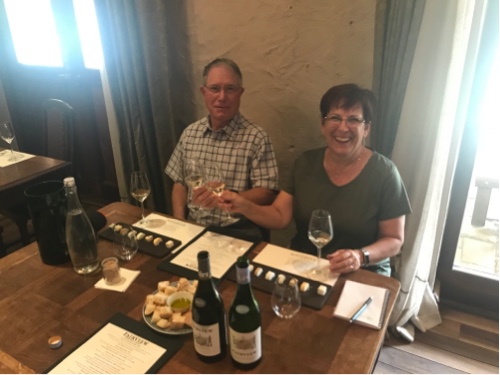
Fairview Estate was our next stop. Here we tasted wine as paired with different cheses made on their farm. We also tasted our first Pinotage wine. This grape was created at a South African university by blending the Pinot Noir grape with a Cinsault (Hermonage) grape and is found only in SA. Wonderful experiece!
If chocolate is your thing then a stop at Spice Route is a must as we got to taste chocolate from very dark to white. Mouth watering goodness! This place was a destination in itself with several restaurants, wine tasting, beer brewing and tasting, picnic and playgrounds.
Our last winery was a disappointment as we were rushed through the tasting because they wanted to close early and the wine was not very good. Warwick Estates was established in 1984 and had a good reputation but we didn’t care for their wines.
We had a late tapas dinner at the Franschhoek Country Inn restaurant and retired early!

Monday, April 30, 2018

Continent of Africa

Top of the Bucket List, and a Grand Adventure, all rolled into one neat package. We flew from Kansas City to Chicago, with a layover of four hours before boarding a KLM flight of 7 hours to Amsterdam. There we waited three hours to fly to Cape Town, South Africa for a 9.5 hour flight to start the adventure of our lifetime! We arrived around 9.30 pm local time (7 hours ahead of cental time), met our guide Owen, and settled into our hotel for a long nights rest.

We awoke this morning to a view of the infamous Table Mountain. Owen recommended that we explore the Waterfront District before heading to wine country in the afternoon. Friday was Freedom Day, the day Nelson Mandela won freedom for the blacks in South Africa and Tuesday will be a May Day Holiday for the workers so Africans have a long weekend and a lot of them spent the day on the waterfront. The clocktower was built in 1862 on Table Bay, the swing bridge was added later for pedestrain access to the quay. Lots of shops, restaurants, bars and entertainment including the iconic ferris wheel are found in this district.

We transferred to the village of Franschhoek (pronouncd Frans - shook) this afternoon where we have a delightful room at the Country Inn. Art galleries, restaurants and souvineer shops are along the main street while vineyards surround the town. Tomorrow we will taste wine from those vineyards.