Showing posts with label Germany. Show all posts

Monday, August 19, 2024

Roman Military Camp

We left our lovely AmaBella Cruise ship and headed towards Prague but first a stop in Regensburg, Germany for a visit to this former Roman military camp from 2,000 years ago and one of the few towns not destroyed or touched by WWII. It is a UNESCO World Heritage site since 2006.


The Gothic cathedral, St. Peter’s Cathederal dominates the skyline and was started by the Romans and has been added on over three different eras but maintained a lot of the same architecture of gothic spires, dark colors, and elaborate decorations around the doors and windows.  Inside the church was comparatively plain.  The crypt has some of the original pillars and scrollwork.


The town reminds us of an Italian city with 21 towers where once there were 10 towers.  Most of these building were created to show wealth and were not lived in above the second floor.


A large multistory building has a fresco of David and Goliath to remind people that the small but unafraid can overcome the giants who threaten them.


We enjoyed a true German meal of sausage and sauerkraut before getting back on the bus and headed to Prague. 

Sunday, August 18, 2024

Bavaria

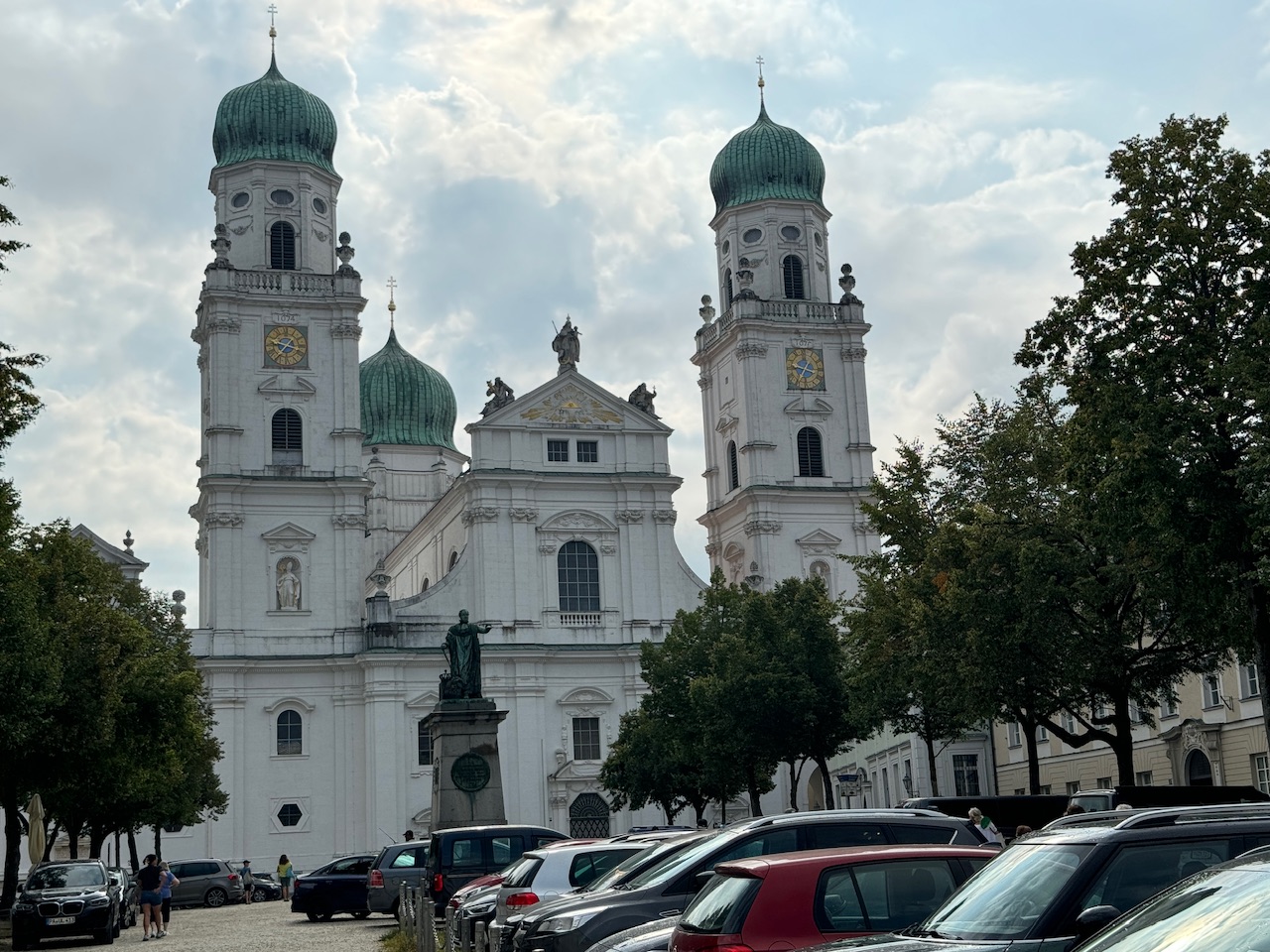
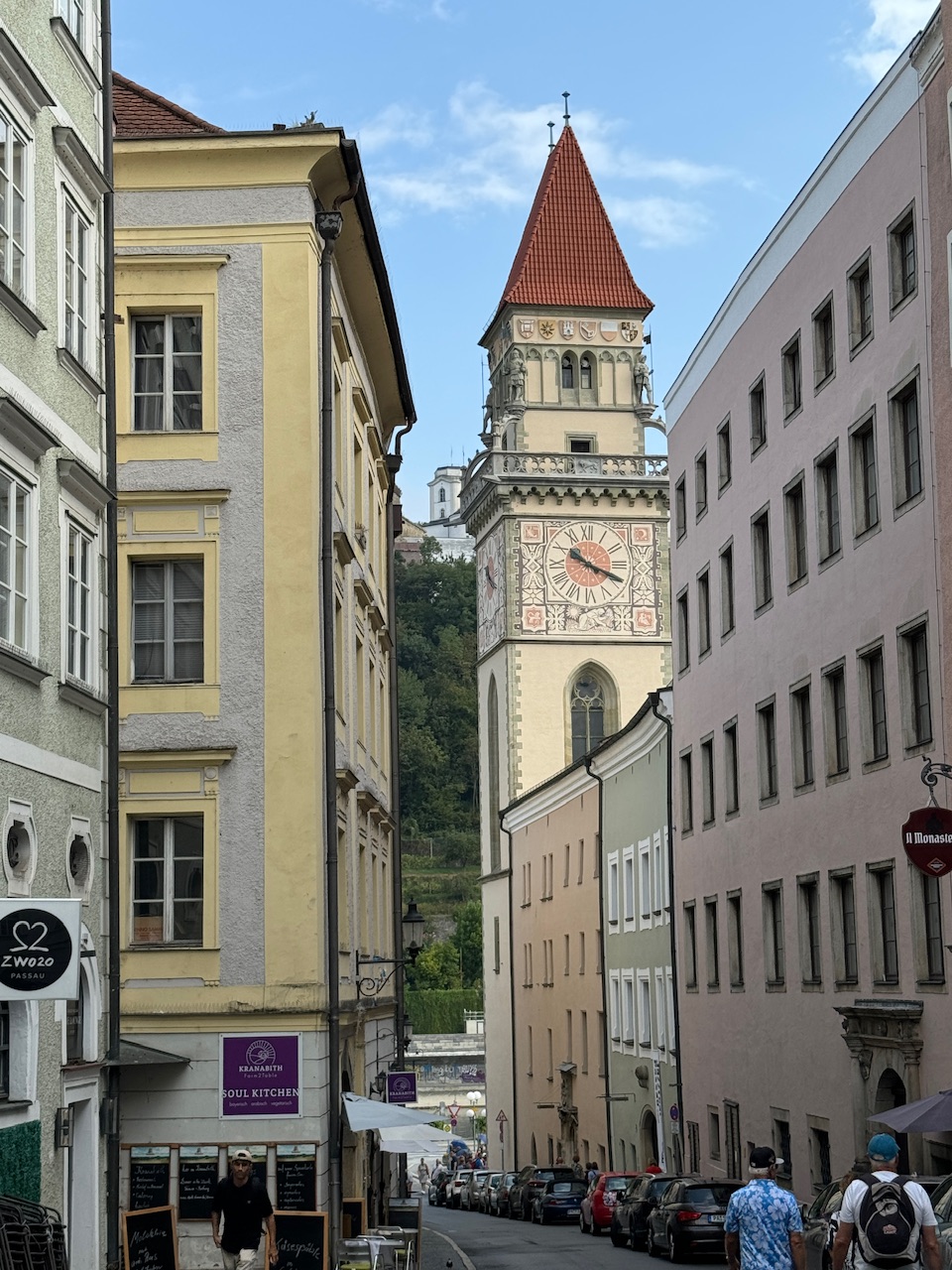
Our first stop in Bavaria, Germany is in the town of Passau.  Bavaria is the second largest state in Germany.  Passau is where three rivers converge, the Danube, the Ila, and the Inn.  A dominant feature in the city is St. Stephen’s Cathedral which was built fairly rapidly over just 25 years, and completed in 1693.  The Bishops palace is next to the church and across the way is the City Hall.  Since it is being used for Sunday services we were not able to go inside the church.


Across the Danube from the main part of town is the Fortress that has been there since 1219 and was used by the Bishop who not only ruled over the church but wanted to rule over the whole city.  Several battles were fought for the city to obtain its independence from the Bishop.


We enjoyed wondering through the town before we headed on up the river to Vilshofen, Germany where we again wondered through the town and, of course, visited a small but beautiful cathederal.  


That evening we enjoyed an Octoberfest style celebration with steins of beer, soft pretzels and music by a local German band with 2 accordions, a tuba and a guitar.  The men also sang and a group performed an amazingly fast dance.


Sunday, July 5, 2015

Rostock, Germany

This is our last port-of-call on our cruise. Rostock has been an important port city for all of Germany but especially for East Germany before the re-unification. With a population of 200,000, the port is important for shipping wood and scrap metal.  This area is very popular as a holiday destination for the Germans with its forested land and blue ribbon beaches.


Rostock was established in the 11th century by the Slavics. St. Peter's Cathederal, the Convent of the Holy Cross and The University of Rostock are the oldest buildings in the Baltic region, built in the 11th, 13th and 16th century respectively.  The University is free to any German student, supported by the government. Outside of the Univ. and the church of the university is a statue of General Blucher who fought with Napoleon and is famous in this region.  We visited the Neuer Market (New Market) where many of the buildings had to be restored after the bombings during WWII.  In the middle of town is a lovely fountain called the Fountain of Joy but is refered to by the citizens as the Pornographic Fountain!!


St. Mary's church is on this square.  During WWII most of the art work and special artifacts in St. Mary's were moved to St. Peter's church with the thinking that St. Mary's may be damaged due to its location.  In fact it was St. Peter's which was bombed along with the artifacts from St. Mary's.  Luckily the items that could not be moved were saved, the 25 meter tall stained glass window and the 5,755 pipe organ among them. The main alter is also original and is 25 meters tall.  Also the Astronomical Clock installed in 1472 was saved.  This clock not only tells the time, date, year, season, moon, sun positions and astrological signs, but the best time to plant and to harest.  It runs out in 2017 so the mathematicians are working to reset it by that year.


Most of the original wall  surrounding the city are still standing but only 4 of the 21 gates.  We saw three of them. The town hall or Rathaus was improved by adding a faux front in front of the original brick walls.

We have to have our suitcases packed and in the hallway before we go to bed.  Goodnight!