Monday, January 23, 2017

Mae Kumpong and The White Temple


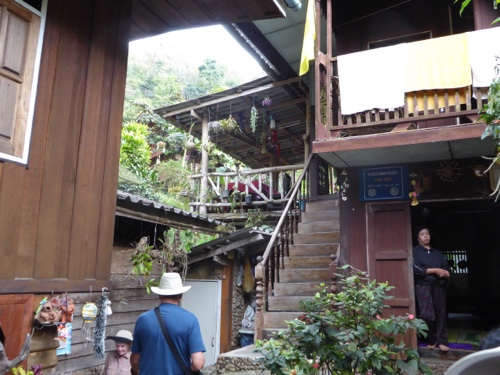
As we departed Chiang Mai we took ua short detour up into the mountains to visit a small village called Mae Kumpong (may cume pong) which is a Royal Project of King Rama IX. He paved the road up to the village, helped to create some better housing, taught them how to run some businesses, planted coffee bean bushes and showed them how to harvest and prepare them to sell to roasting companies. Now it is becoming a popular tourist destination. Our hostess led us along the steep paths through the village to the waterfall showing us tea plants, coffee bean bushes and other plants that they use for food, seasoning or for making brooms or thatch for roofs. The waterfall is their source of fresh water.
We ate lunch upstairs on the porch.
We then had lunch at another family home. We had stopped at a market and purchased green eggplant, bok choy, garlic, and peppers on our way up. She made a chicken soup and stir fried vegetables served with rice. It was very tasty.
Just outside of Chiang Rai is The White Temple, or Wat Rong Kuhn, created by Chalermchai Hositpipat. He had a vision of what the transition should be like from the things of earth to heaven. On his own and with his own money he has created this Buddhist temple. He is a world renowned artist in painting, colored pencil, sculpture and many other mediums.

Saturday, January 21, 2017

Elephant Ride!

Our first stop this morning was at a market, seemingly out in the middle of nowhere, that is famous for the Thai delicacies found in some of the stalls. It's amazing how many of the vegetable they find to eat and to cook with such a variety of herbs and spices, most I've never heard about.
Because we drive right past the Elephant Conservation Center and Elephant Hospital, we convinced our guide to stop so we could ride an elephant! As we entered the grounds a group of elephants and their trainers, called mahouts, were coming towards us. The baby elephants, 4-5 years old, were leading the way. One of them was very interested in us and ran its trunk all over Susanna's face, as if it was kissing her! What a treat! The adult elephants then paraded past us.
Eash couple rode an elephant on a seat with the mahout sitting on the elephant's neck. The first thing we did was to walk into a small pond so the elephant could pose with us for a picture. Our mahout told us the elephant we were riding was a 23 year-old female named Pa Tee Dee. She loved the water and tried to spray the elephant in front of us. Then the mahout tickled her behind her ears and she laughed! It was just as I imagined it would be - fabulous!!
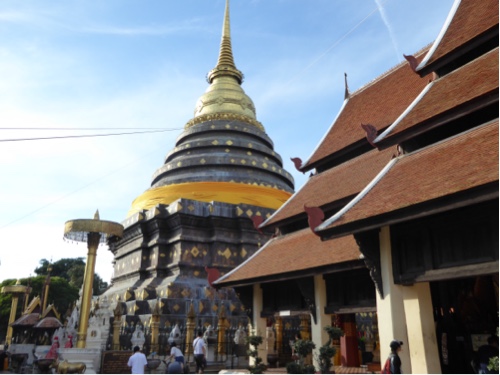
We stopped in Lamphun to see the oldest temp Lin in the Chiangmai Mai District. Since they had had a funeral ceremony for the recently deceased king, they had decorations up all around the temple grounds. There were many chapels that contained a gold Buddha or two or three but the dominating feature was the real gold covered chedi that was a cross between a pagoda and a stupa. It has a square base and the round spire. It contains a small royal relic of the Buddha.
Silk Worms
We entered Chiange Mai (pounced "chi-ang my" but it is pronounced so quickly it sounds like "chang my"). This city of 2 million was once the home of our guide so she had lots to tell about her city. We visited a craft area to learn about making silk, paper umbrellas and wood working. For supper we walked along the night market and found some street vendors with some very good Thai foods

Friday, January 20, 2017

Sukhothai


The official alphabet of Thailand was developed in this town by the king. It has 44 letters, 22 vowels and 6 tonal sounds. We rented some really old, used bikes to ride around the Historical Park, an Unesco Heritage Site. The original casting of la Buddha was made in this temple and most other Buddhas are based on this casting. There are many monuments in the park, some complete stupas and some just their bases. The centerpiece is the triad of pine cone shaped stuapas called Prangs because they were made by Cambodians who resided here at the time they were built. The Emerald Buddha that we saw in Bangkok resided at this temple at one time.
We learned more about the differences in each Buddha we see. We looked at the hair, the lips, ears and chin shape, the hands and the stole. One Buddha we saw was standing 9 meters tall and another had a 7 headed snake rearing up over its head as a sign of protection.

Thursday, January 19, 2017

Lop Buri and Phitsanulok

Lop Buri is pronounced "Lope - Burnee" and is the home to a very unique group of animals. The Macques Monkey have overrun the central part of town! In the square is a group of three stupas built by the Cambodians in the 1300's and surrounded by a relatively modern hotel and other shops. At some point in time the monkeys came to town and decided to live in the square and then needed more room. Hotel guests were run out of their rooms by the little monkeys when they would rattle the doors and disturb the guests. They eventually had to close all the buildings and they are now run by the monkeys. Even tourists have to be wary of them. When we walked up, one monkey jumped on the back of our guide! A local chased it off and for a few dollars kept them off of the rest of us while feeding them and giving us a show.


Also in this town is a temple complex that is older than the city and maybe older than Thailand. Due to the shapes of some of the ornamental towers, they have dated the complex to the 1300's but some buildings are from the mid-1600's.


We had lunch in a lovely jungle retreat with our own pavilion and shared plates of delicious Thai foods.


A short drive later we stopped to see the most beautiful Buddha known in a temple named Wat Mahathat built in the 1100's. We also visited a Thai Folk Museum.

The most fun of the day was tasting a Thai delicacy of Fried Bugs!! We ate bamboo worms, silk worms, crickets, grasshoppers, flies, roaches, frogs and chicken skin. All was washed down with Thai Saki!! They didn't taste too bad, mostly they had the flavor of the oil they were cooked in.

Wednesday, January 18, 2017

Ayutthaya

We left Bangkok today to head north to the former capital of Thailand, Ayutthaya (pronounced Ah-you'-tee -ah). It was the capital for 417 years from 1372 to 1767 but during that time Burma attacked the city 44 times in as effort to invade and take over Thailand. Therefore the many temples in the city were nearly destroyed.

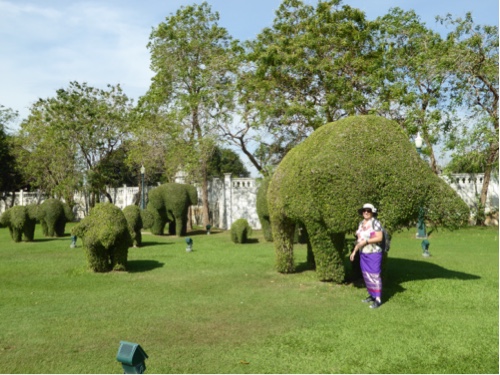
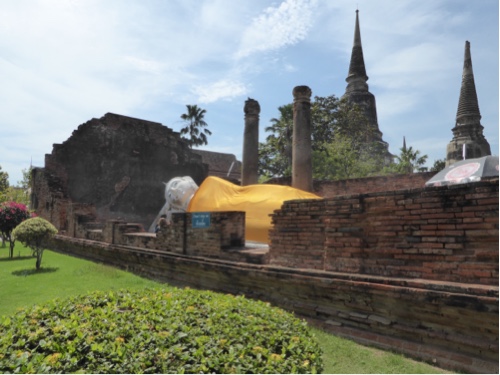
Our first stop was at King Rama V Summer Palace called Bana Pa-In. His father had built a pavilion in the jungle many years before he became king so when Rama V found it, he had it restored and built many other buildings around it, flooded it and made it his summer home. We also visited a Buddhist temple that resembles a Christian church because of the style and the stain glass windows. Near here were a couple of Buddhas in different positions.

In Ayutthaya we rode in Tuk Tuks to visit some of the temples located in the Historical Park. The Victory Temple is the biggest and tallest Stupa in all of Thailand built in 1557. A stupa is a round pagoda built to honor Buddha . Royalty and monks had their cremated ashes placed inside the stupa so that they can reach heaven. While there we witnessed the ordination of monks.

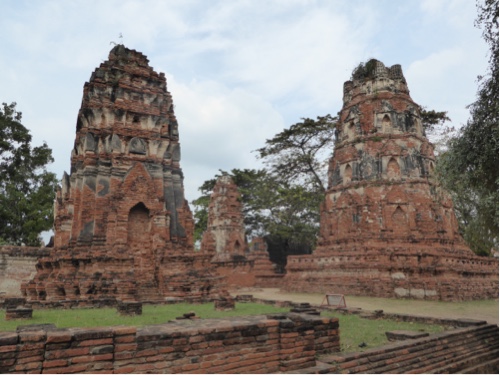
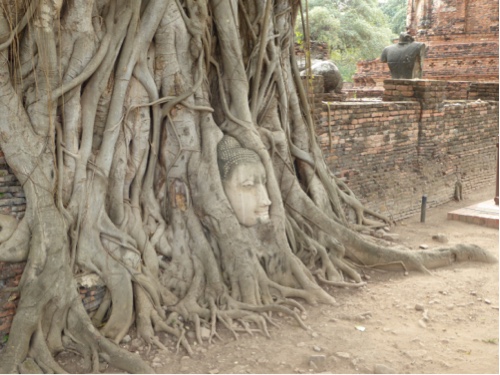
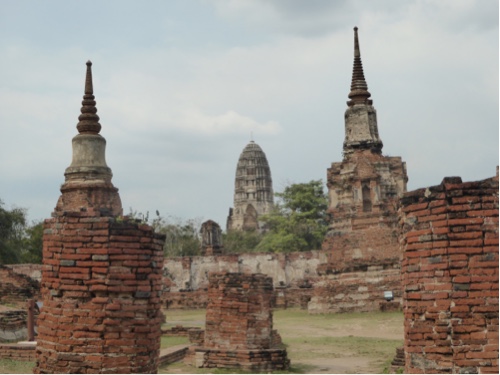
The next stop was Wat Maha That (pronounced 'tat'). The head of a Buddha statue had fallen off and was trapped in the roots of a tree. We compared the shape of the various chedi called stupa, prang or pagoda depending on the shape of the base. All reach to the heavens. A tuk tuk ride to another site showed the chedi in better preservation so more detail was visible. Most of what we saw were constructed in the mid 1700's and contain the relics of royalty.

The last stop was at Wat Phra Si Sanphet, a huge complex of temples, stupas and prangs. Each king had his own stupa or prang for his creamated ashes and a building for the burial ceremony. The palace was nearby so the king could easily walk to the temple to worship.
It's been a long, hot and muggy day. Time to cool off, refresh and rest.

Tuesday, January 17, 2017

The Thai Countryside


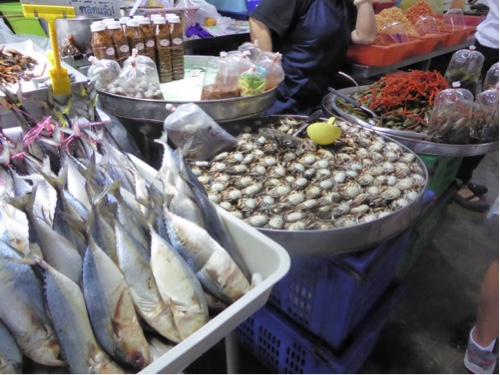
A few miles South and west of Bangkok is the village of Samut Songkhram where we enjoyed experiencing the rural life of Thailand. Since this village is close to the ocean our first stop was at the fish market. You cannot imagine all the different gifts from the sea! Snapper, tilapia, crabs, prawns, huge squid, live clams live catfish and so much more! Next to the fish was the fresh produce with vegetables and herbs I've never heard of! Pink eggs (pickled), chicken, duck, meats and more!!

The next stop was the floating market. Farmers started this tradition to bring their goods to market to trade with other farmers. Then they started bringing food to cook and share, then the tourist and locals wanted in on it and it grew! Everyone is selling from their boats - trinkets, fried bananas cooked while you watch, fresh fruit cut and prepared while you watch, fish, vegetables and more! Booths are set up on shore too selling clothes, carvings etc.

The third market we visited was also very unique. It grew up along a railroad track that is used by a train only three times a day. The vendors set their wares and foods along either side of the rail, cover the booth with a canvas lean-to to keep out the sun and when the train arrives or departs they move the canvas lean-to back away from the train, roll the foods or goods back from the track and wait for the train to pass before moving it all back into place. It was fun to watch but don't blink! It happens quickly!

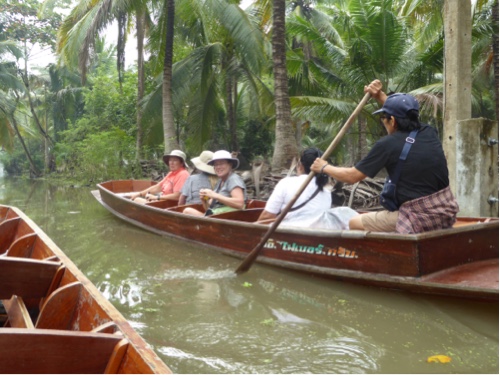
The coconut tree is very important to the Thai people as every part of can be used for something. One part that is unusual is the syrup from the flower. It is gathered much like maple syrup, boiled down over a wood burning stove, cooled and sold at market. It tastes like a very mild molasses. Following this demonstration we rode in a paddle boat around the coconut farm then got into a long-tail boat for a 45 minute ride down the river and back to the village.

On the way back to Bangkok we visited a 1553 temple held together by the roots of a ficus tree and the home of King Rama II who had a love for the arts, including puppets made from cow hide in a lacy and ornate fashion.

Dinner tonight was on a repurposed wooden river rice barge where we saw many beautiful sites lite up and shining on the river.