Wednesday, November 10, 2021

Crocodiles, Markets and Nubians

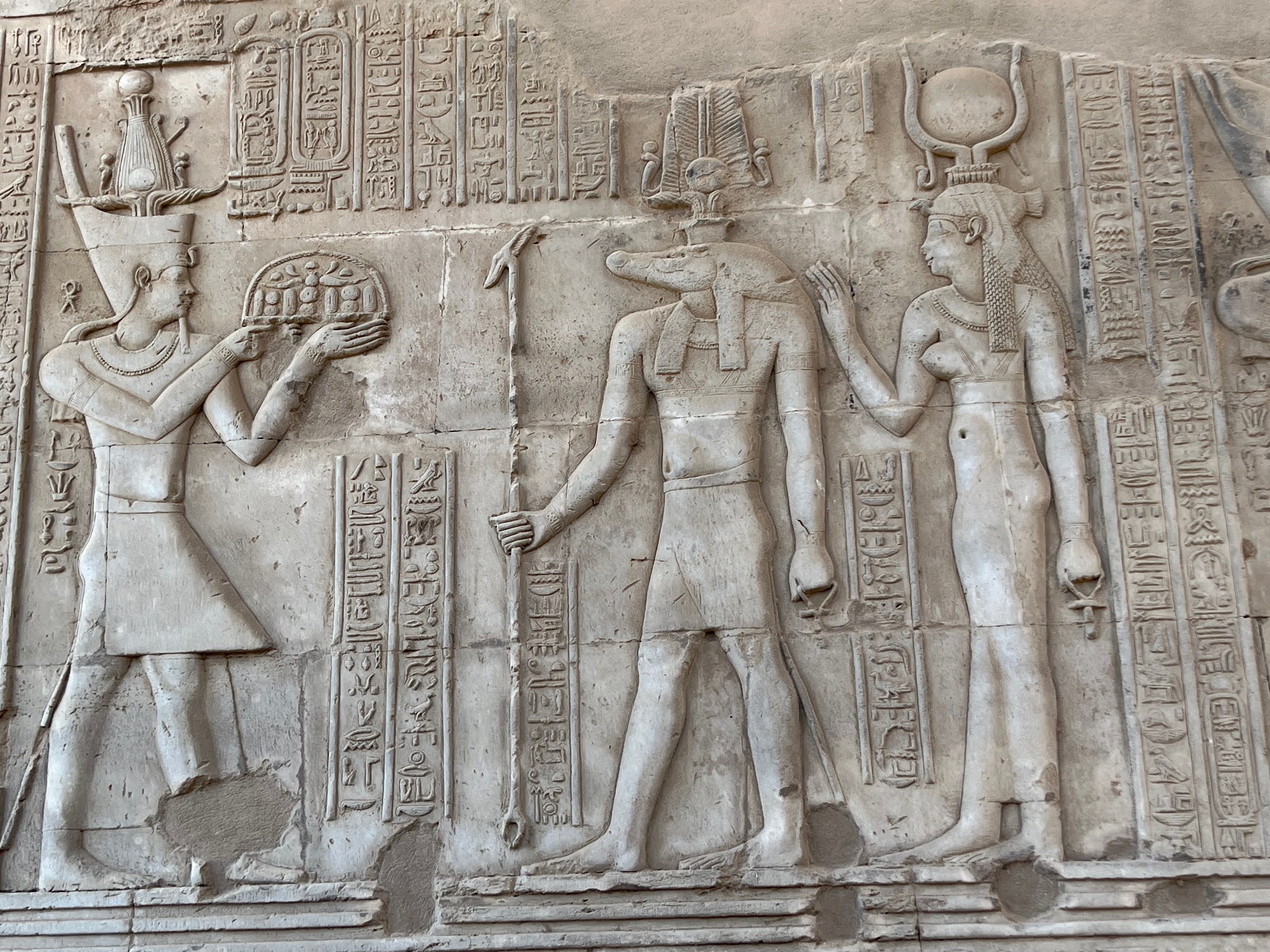
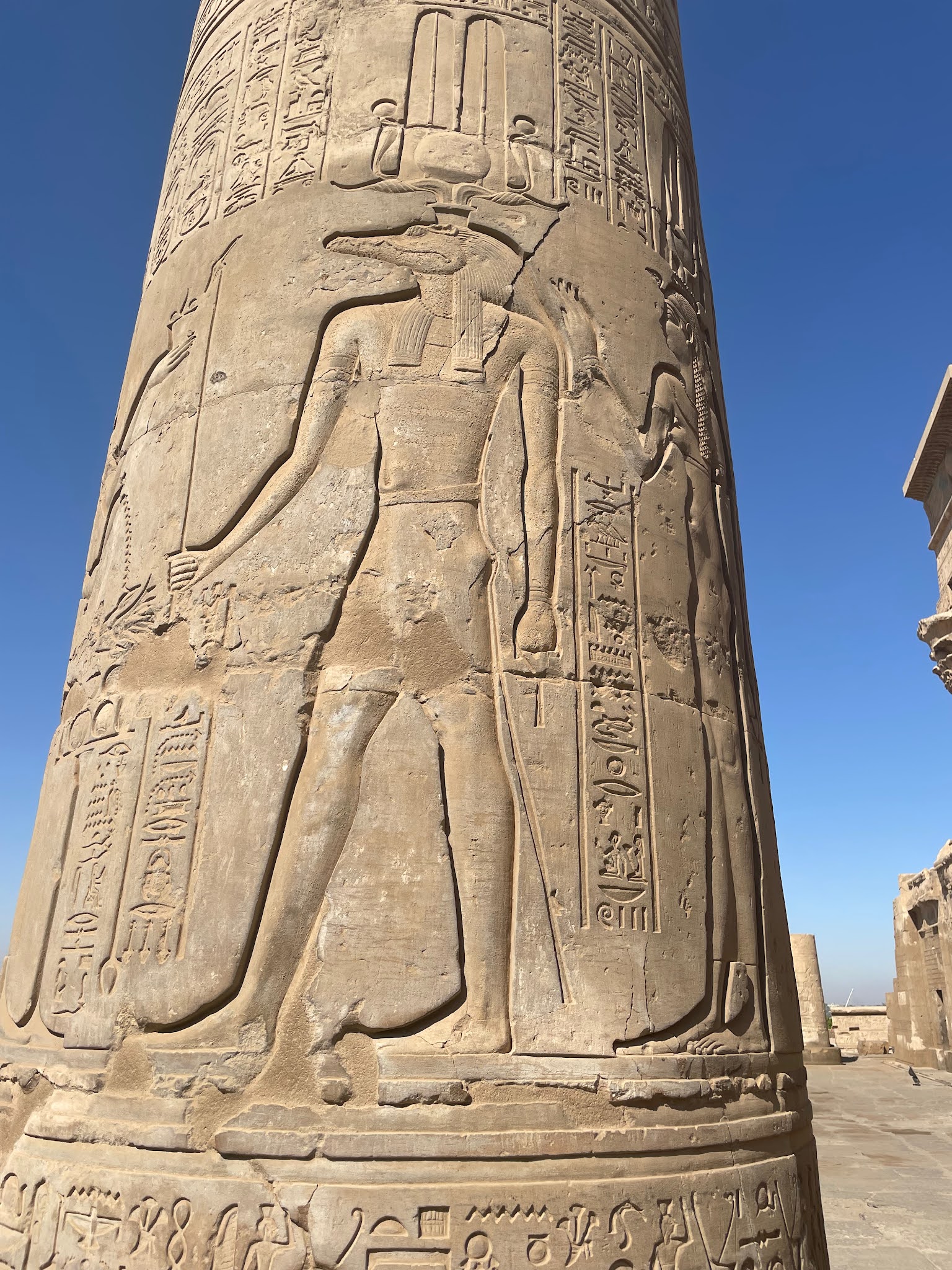
Wednesday November 10 -   Kom Ombo is 45 miles north of Aswan.  It a thriving town with a very interesting Temle dedicated to two gods which is unusual.  Circa 200 AD crocodiles could be found north of the dam area since in those days there was plenty of marshy and stagnant waters for them to live in.  There was an island of dry sand in the Nile where the crocs liked to sun themselves and because of this the Egyptians saw the mound of sand with the crocs as the beginning of creation.  The temple is dedicated to Horus the falcon headed god and to Sobek the crocodile headed god.
As is the an with many temple it was filled with sand which preserved the pillars, hieroglyphs and buildings but it also made way for people to build their homes between its walls. The early Egyptians worshipped the crocodiles so they feed them and when they died they embalmed and mummified the bodies, burying them in a pit near the temple.

This temple is important to Egyptian history because of the detail the stories told in the hieroglyphs on the walls. We tried to recreate one scene with Ra at the center facing the king and on either side of these two figures were more gods to show how the drawings were very artistic and not realistic.
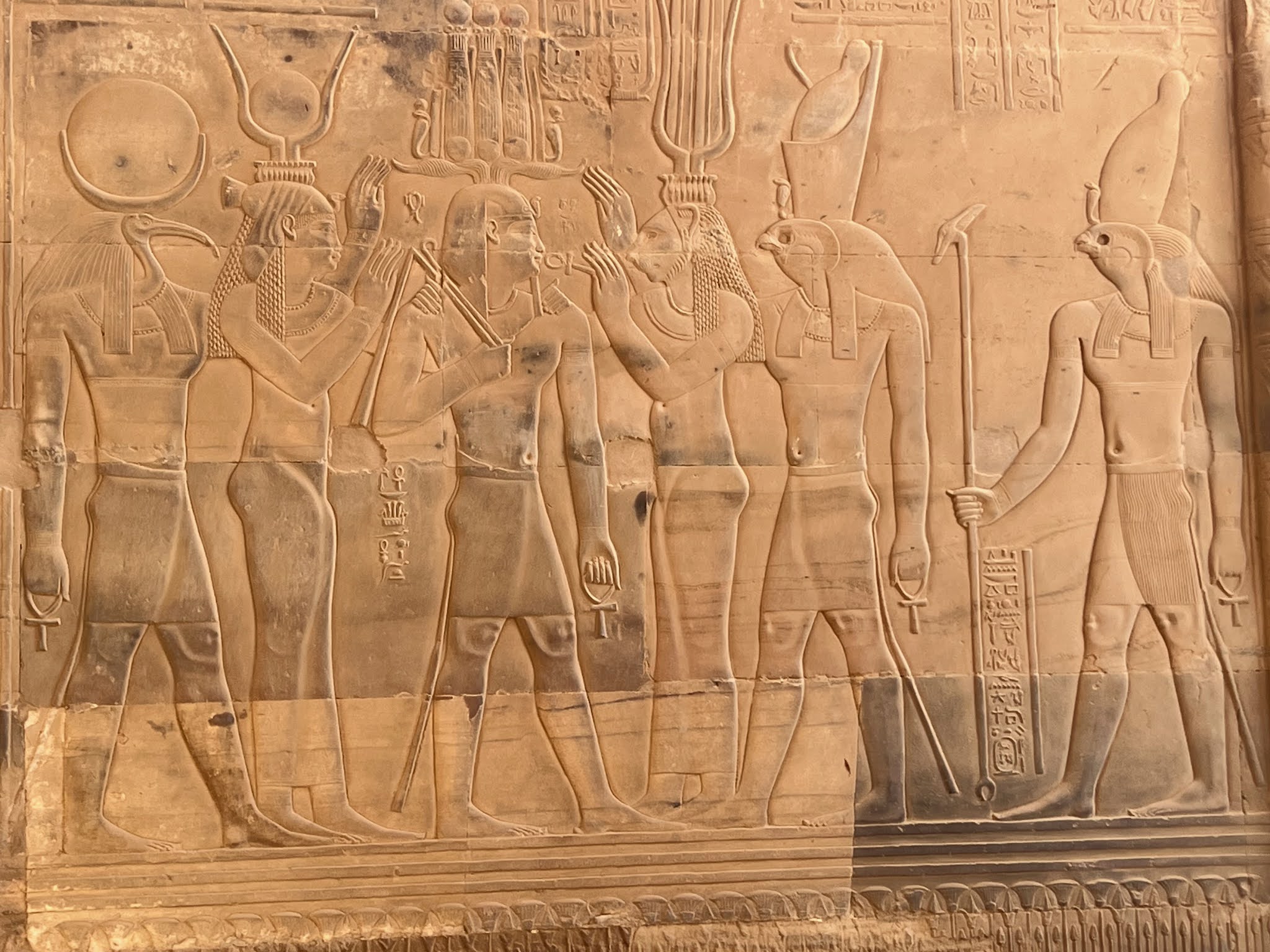
We also discussed how the Roman calendar came into being because of the almanac the Egyptians etched into the wall of the temple.

Just outside the temple walls an ongoing excavation is taking place and next door is a display of mummified crocodiles.
Part of our group followed the chef into town to peruse the market and to buy provisions for the boat.  We traveled in tuk-tuks and got to experience life in the city.  Schools were letting out for lunch, traffic was horrendous, the side streets were dusty, narrow and decrepit.  The market was busy and very lively.  The girls in the group enjoyed looking at all the varietyies of produce, spices and seeds.
A short cruise later we stopped at a very small Nubian village of about 2000 people to visit with friends of Ahmed and to see how these village peoples live.  This friend has 5 girls and one boy who are all very beautiful and sweet. The mom had recently started work at the hospital.

Tuesday, November 9, 2021

Cutting Stone

Tuesday November 9 - The day started leisurely with no tours in the morning.  Shortly after lunch we pulled ashore at the Sandstone Quarry.  All the great temples use the stones from these mines in their creation.  A whole community of people would live in a village near the quarry, living and dying and being buried here.  The bones of these villagers told a story of a hard life with many deformities due to lifting or cutting these heavy rocks.

We are viewing the cuttings on the west side of the Nile which have a lesser quality of rock than on the east side but it shows us lessons about cutting the stone.  We can see the marks where the cuts were made, how the rock was split and where they sharpened or honed their tools.  Some of the casing stones for the pyramids were cut from this site with the unused ones tumbled on the ground. The loading ramp to the river is also apparent.  When the Romans occupied this area they wanted to tax all the trade along the river so they chose this spot to set up two chains across the river to stop and hold any ship going past. The holes they drilled in the stone for the rope pulley are still evident.
A shrine is also carved into the sandstone to Hormbheb the beloved chief of the Egyptian army in 1360 - 1338 BC.
It’s a busy river the closer we get to Aswan.  We pulled to shore with about 7 other boats.

Monday, November 8, 2021

Cruising the Nile

Monday November 8 — We wake to a cool morning and enjoy a leisurely breakfast before taking a walk through the village and along the walls to the fort called Kab.  The fort was built circa 4000 BC to protect the village, the cemetery, temple and all the soldiers housed there.  The walls of the fort are protected so the villagers cannot build next to them.  The cemetery is not a royal one but it did hold the remains of the governor of the fort and nobles from the region. Thirty nine tombs were found here.
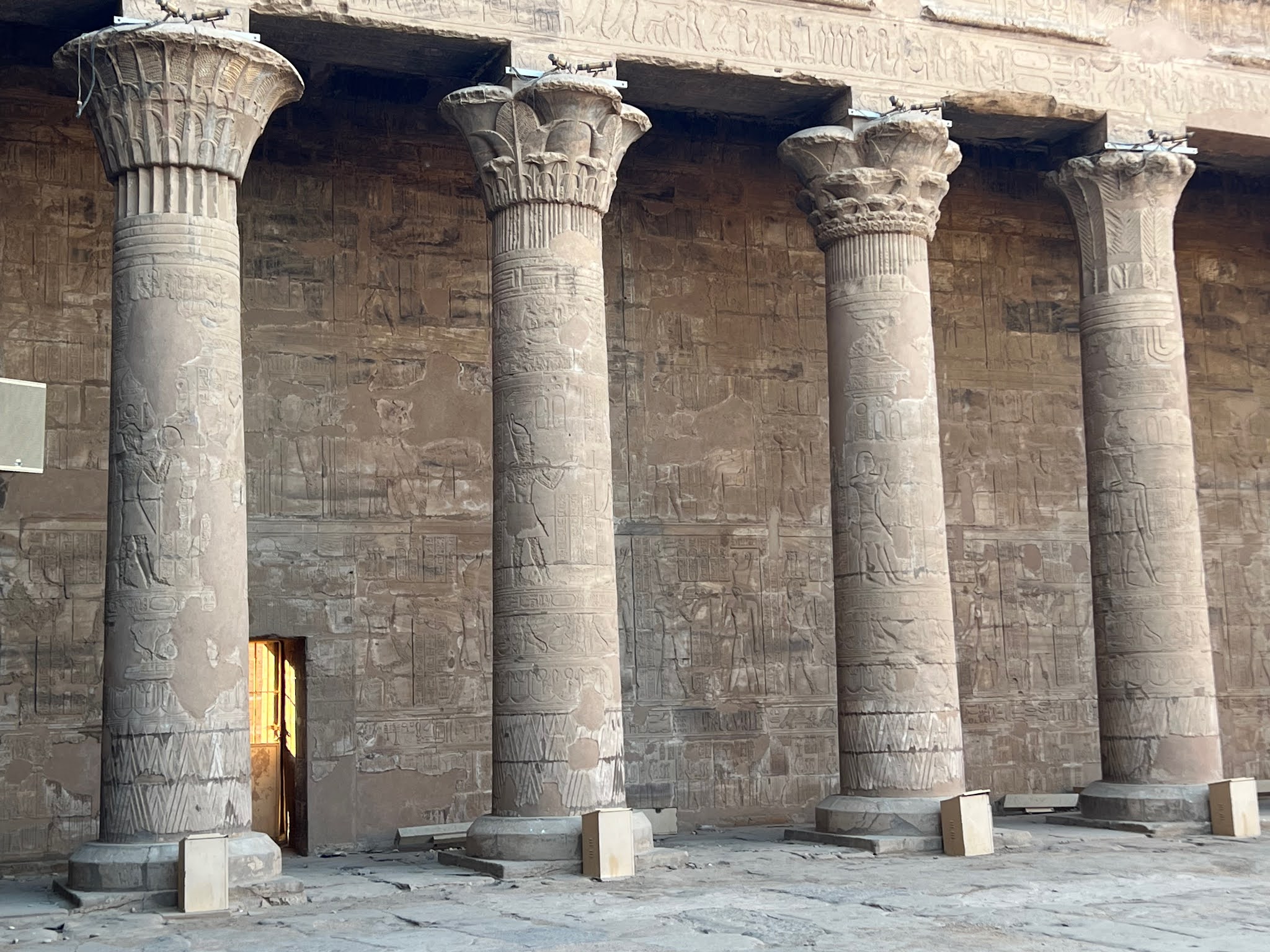
After lunch we stop again so we can ride our “chariot” to see the Temple of Edfu  which is dedicated to Horus, the god with the falcon head, and he is the son of Isis.  Pictures show the Pharoah smiting the enemies of God Horus while Horus’s mother and wife watching.
When excavation was done in 1880’s the town had already been built on top of the temple.  The sands of time had covered the temple up to near the top but the capitals and the upper hieroglyphs were visible and had been erased or written over with graffiti and in some instances used for  target practice.   This is one of the best preserved temples from the ancient world because of it location in Egypt.  People, flooding, invasions and weather is what ruins all temple but in this regions those effects are greatly reduced.
The sanctuary is surrounded by 11 rooms, a pillar courtyard and the walls are covered with detailed hieroglyphs.  This temple is from the 1st century BC.  Translated in 1931, the walls are covered with over 8000 different signs and symbols.  This is the first time a symbol for a chariot has been found.
The falcon statues are from modern times and were a gift from the French to Egypt.
When we stopped for the evening the crew prepared a barbecue dinner for us with ground lamb and skewered chicken and traditional side dishes, salads, soup and desert.  The dinner was set on the shore. We ended the evening (at least Ahmed, Josh and I) by smoking a hookah pipe.  Lots of laughter and jokes.


Sunday, November 7, 2021

Valley of the Queens and Kings

Sunday November 7 —  On our way to the east side of the Nile we stop to admire the Collossi of Memnon built circa 1500 BC from single blocks of stone that had eroded and was reassembled in the 1800’s. More statues are currently being reconstructed along a path to another temple.

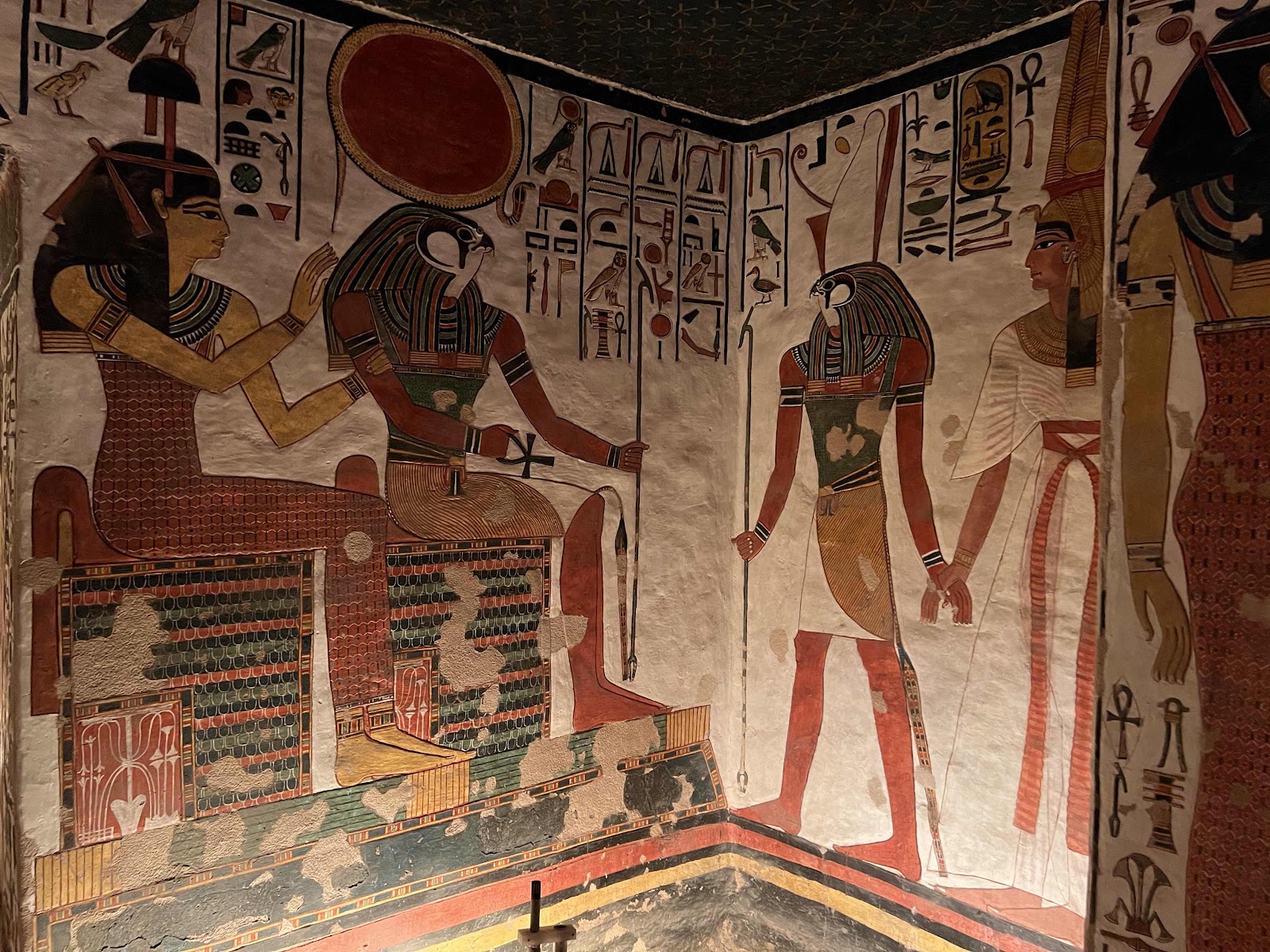
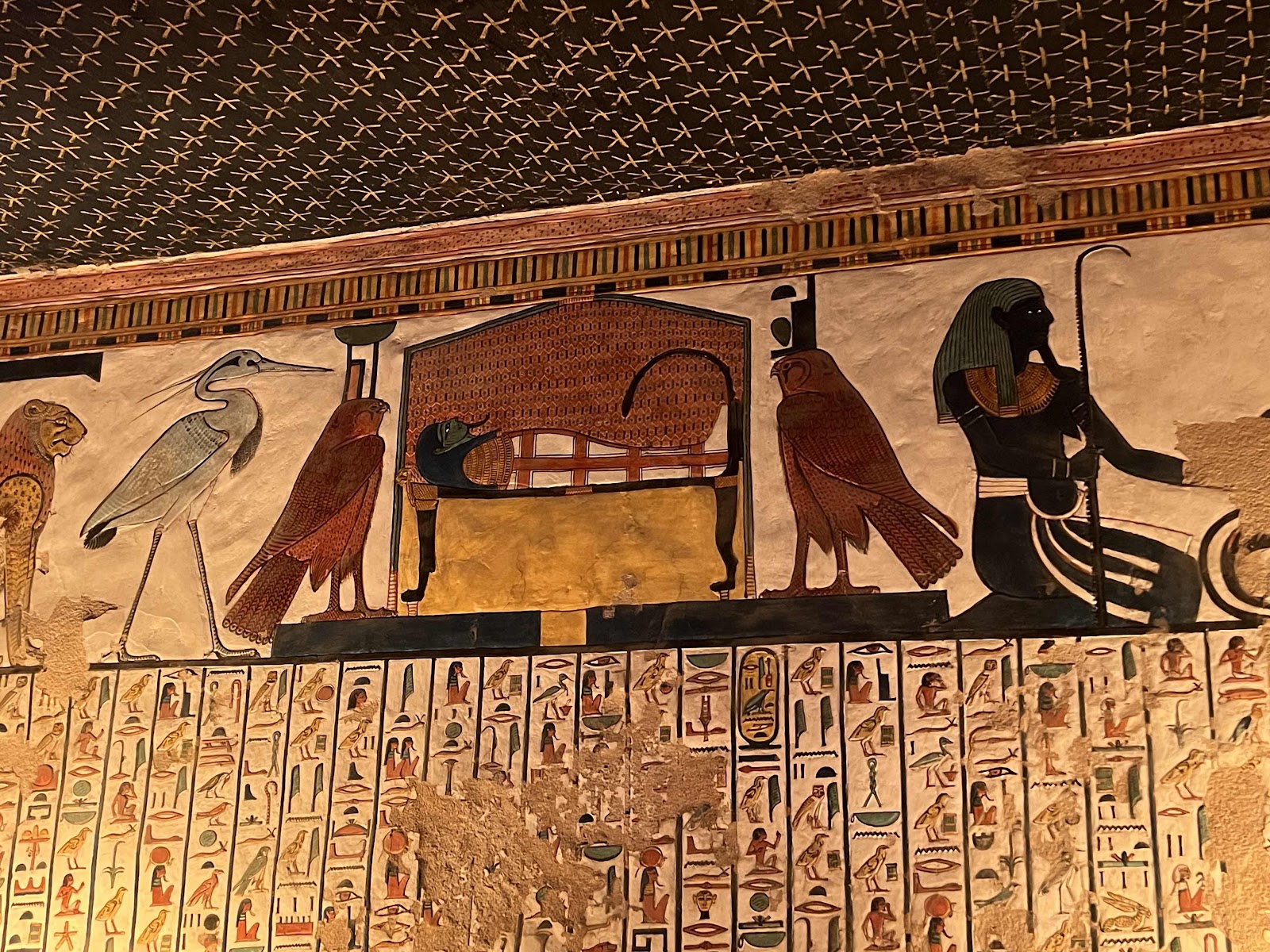
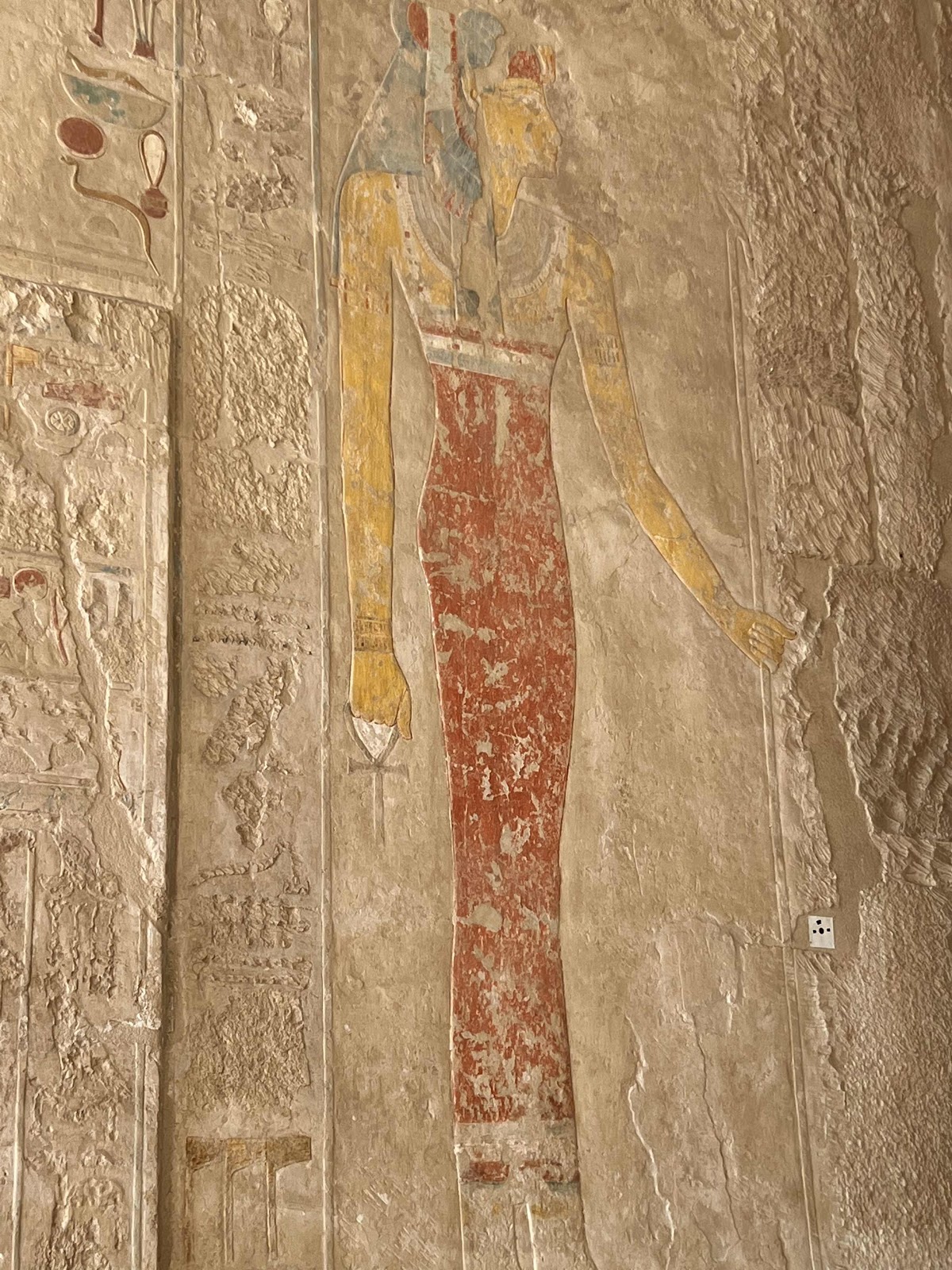
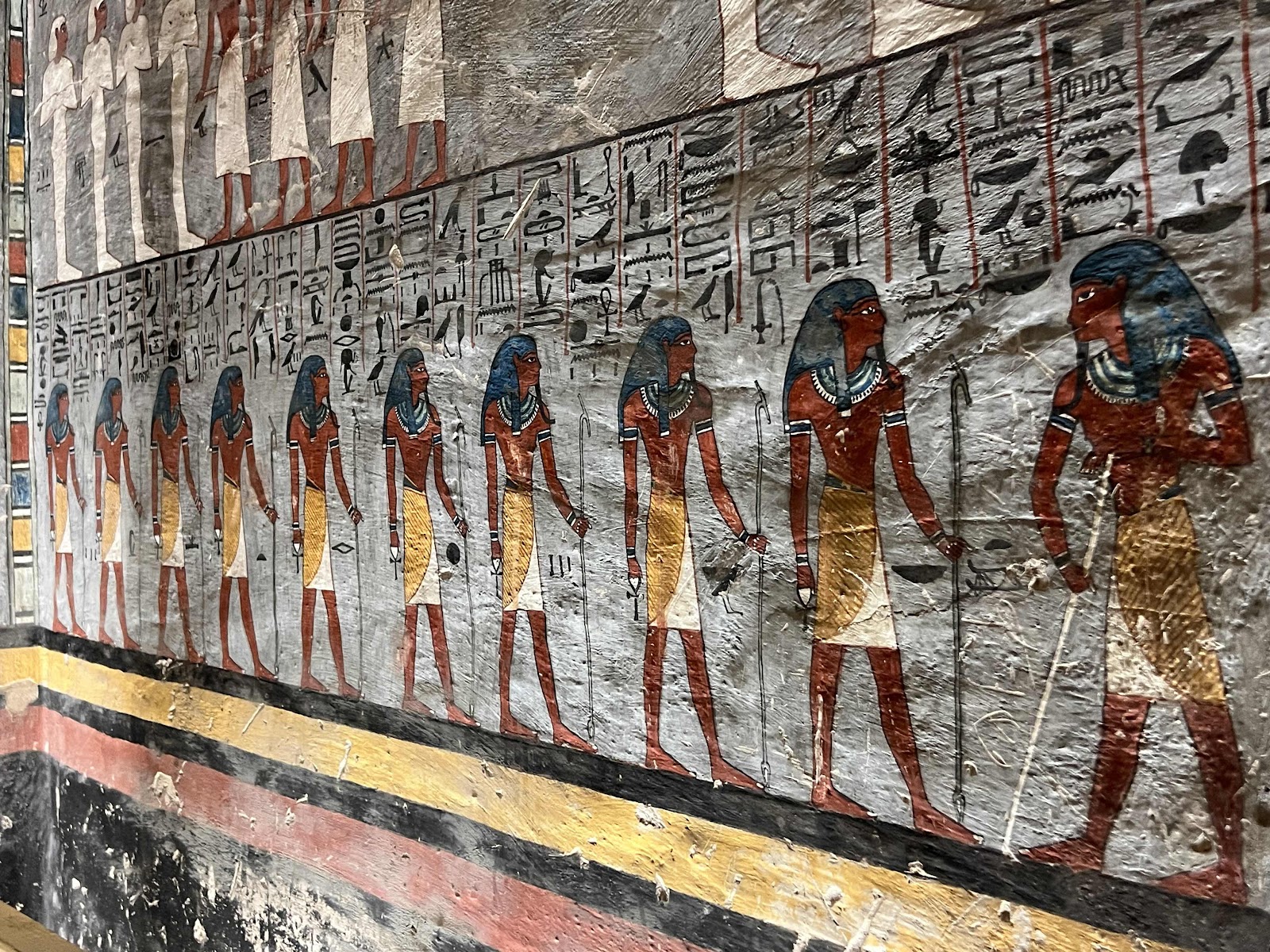
The Valley of the Queen has over 80 burial sites that were discovered 1902.  The average tomb was dug out of the mountain side, then a protective wall was installed which is covered with plaster before being painted.  Our first stop was to the Tomb of Nefertiti, the first and favorite wife of Ramesses.  The hieroglyphs show the gods of the Netherworld who will guide you through and return you to the ‘light’.   Four square columns surround the queen’s sarcophagus.


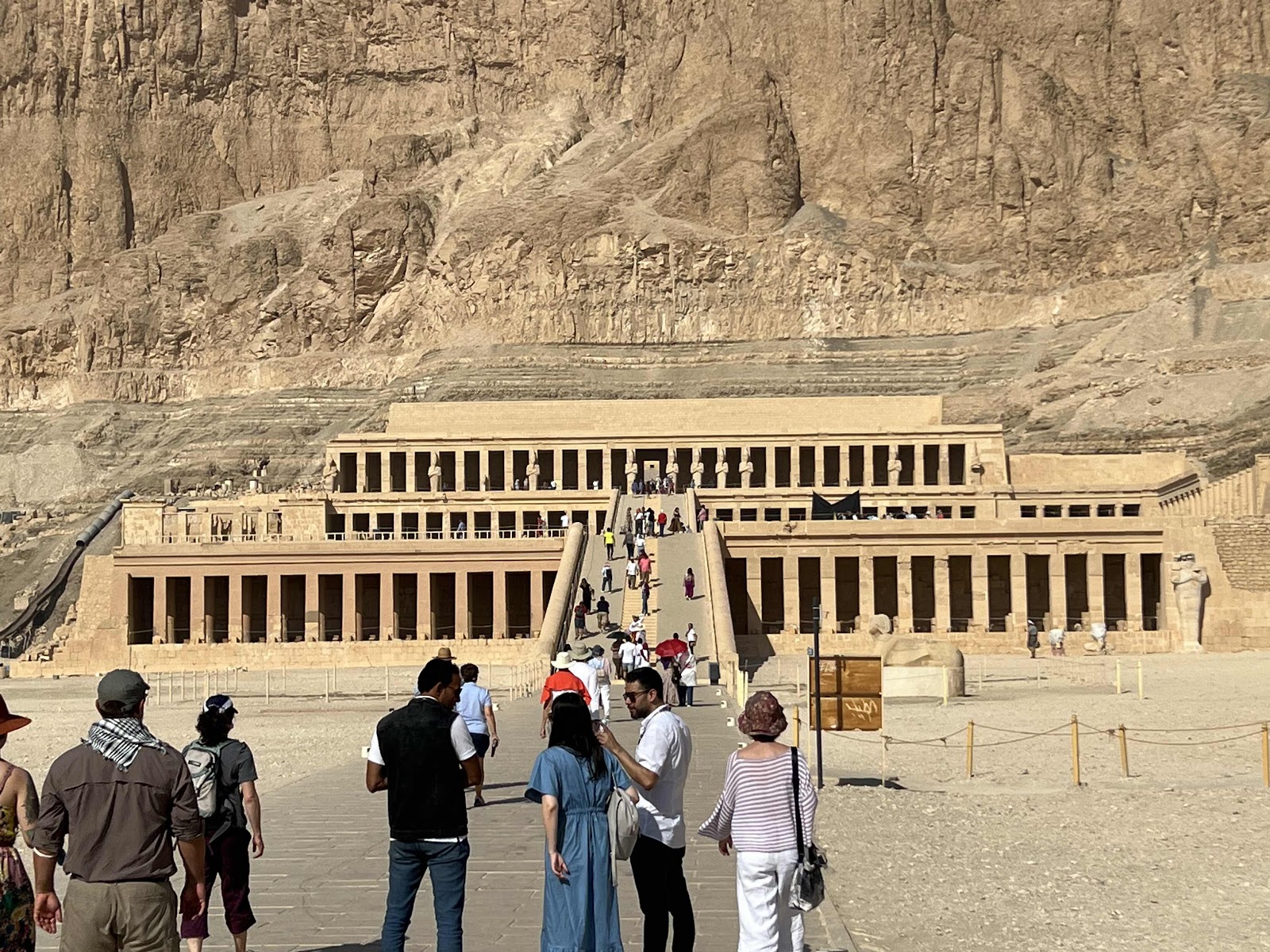
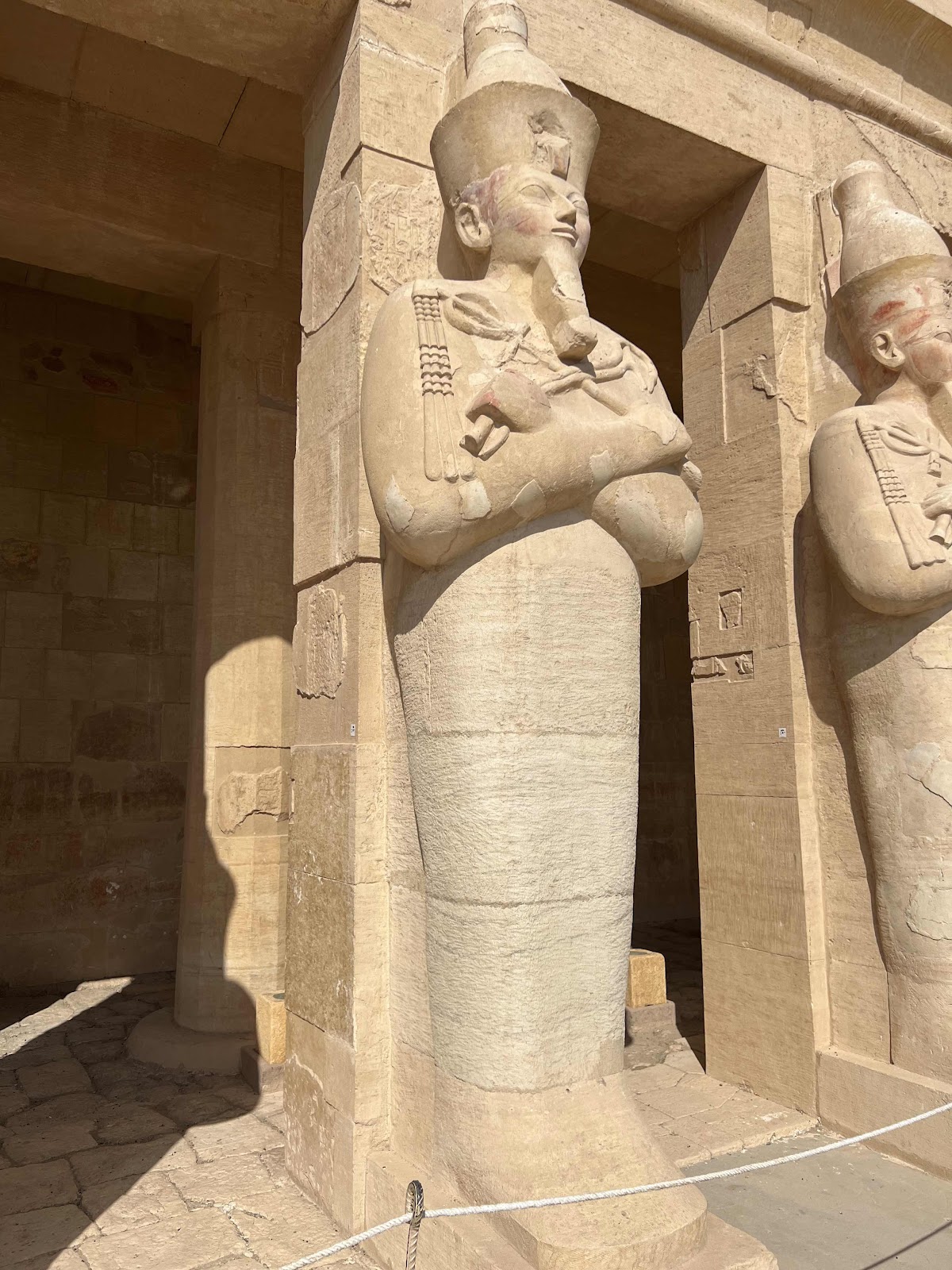
The Temple of Hatshepsut was built to celebrate her life at a time when Egypt had reached stability and wealth.  The temple is perfectly aligned with Karnak and had an avenue of Rams from the temple to the Nile.  We climb stairs to the courtyard then up again to the upper terrace with areas dedicated to the exploration of Africa, the divine birth, and Anubis the black Jackal.  The third floor shows the boat of Ammon.  The whole complex has been heavily restored with only about 20% original material.


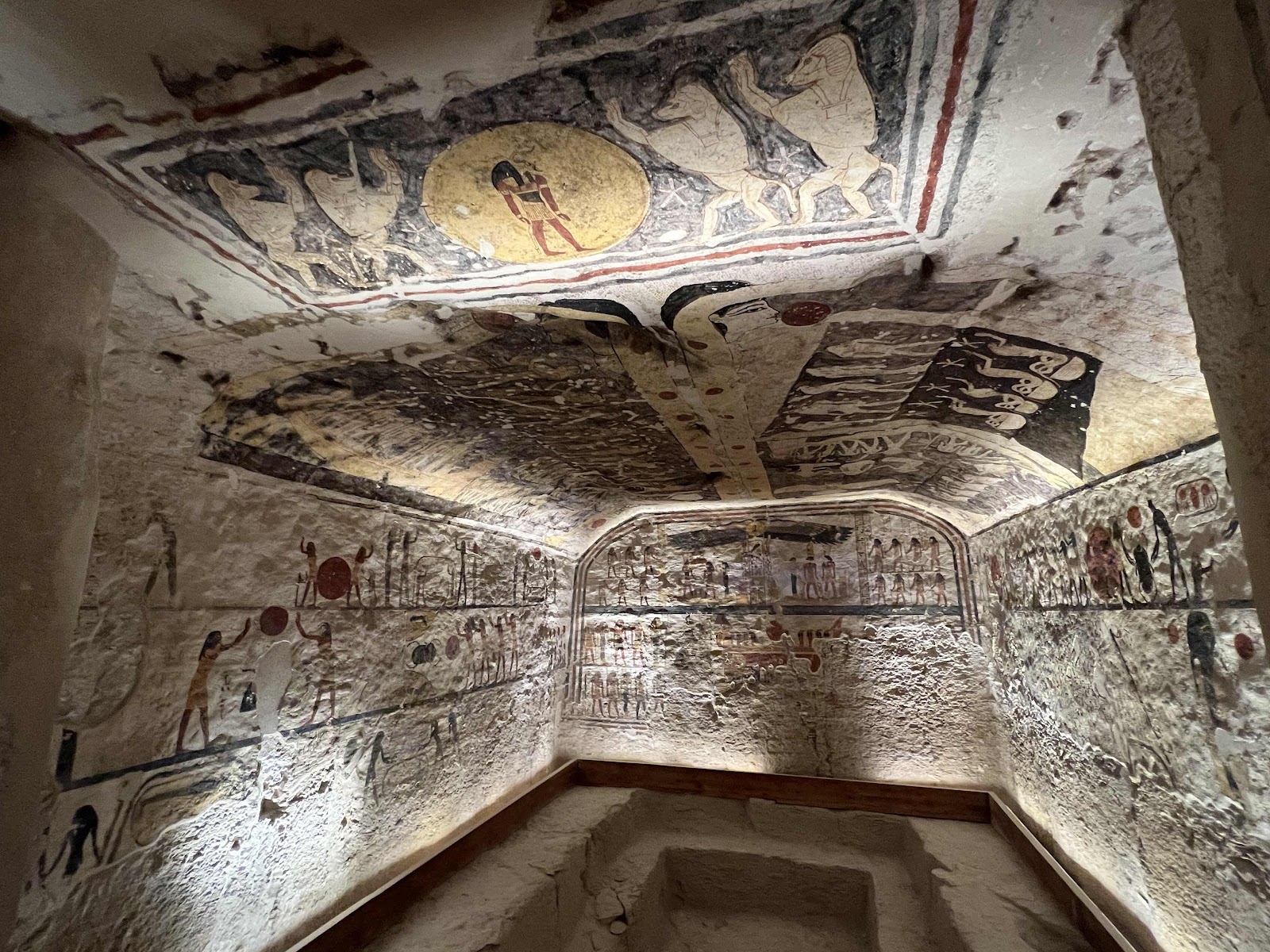
The Valley of the Kings is on the other side of the mountain under a pyramid shaped mountain. They have found 63 tombs but more are being uncovered.  Burials were from 1550 - 140 BC.  Most tombs were dug before the kings died.  Tomb raiders were active as early as 900 BC.  They were raided for the items buried with the mummies and since jewelry and gems were wrapped with the mummy, the mummies were torn open or taken as well.  All that was left were the beautifully painted walls and the stories that tell the history of Egypt.  In 985 BC 55 mummies were moved to a cave near Queen Hatshepsut but King Tut’s tomb was well hidden and was not disturbed.  

King Ramesses I tomb was discovered in 1940 but they didn’t really realize what they were seeing until it was rediscovered in 1995. It was filled with all of Ramesses children.  This was the largest mausoleum found at 6000 sq. meters when the average tomb is around 600 sq. meters and King Tut’s is the smallest at 60 sq. meters.

King Ramesses IX was from dynasty 20 and his tomb was discovered in 1880.  Ramessses XI was the last to be buried here.

King Tut Ankh Amunn’s  tomb was discovered just a few years ago and still held all his treasures, his mummy and things from his daily life.

When we left the valley, we drove south to Edna where we boarded our boat The L’Orient to continue our journey on the Nile up river to southern Egypt.  After a late lunch on the boat, three of us walked into town to visit the Edna Temple. It’s a small temple as compared to Luxor but it is well preserved since it was under the sand for so many hundreds of years. Recent cleanings have revealed the beautiful colors on the pillars.

We cruise for a very short time before we pull to shore after dark.

Saturday, November 6, 2021

Karnak and Luxor Temple

Saturday November 6 — What a day!  We were up at 4 am and flew to Luxor from Cairo to start touring by 9 am, trying to beat the heat.

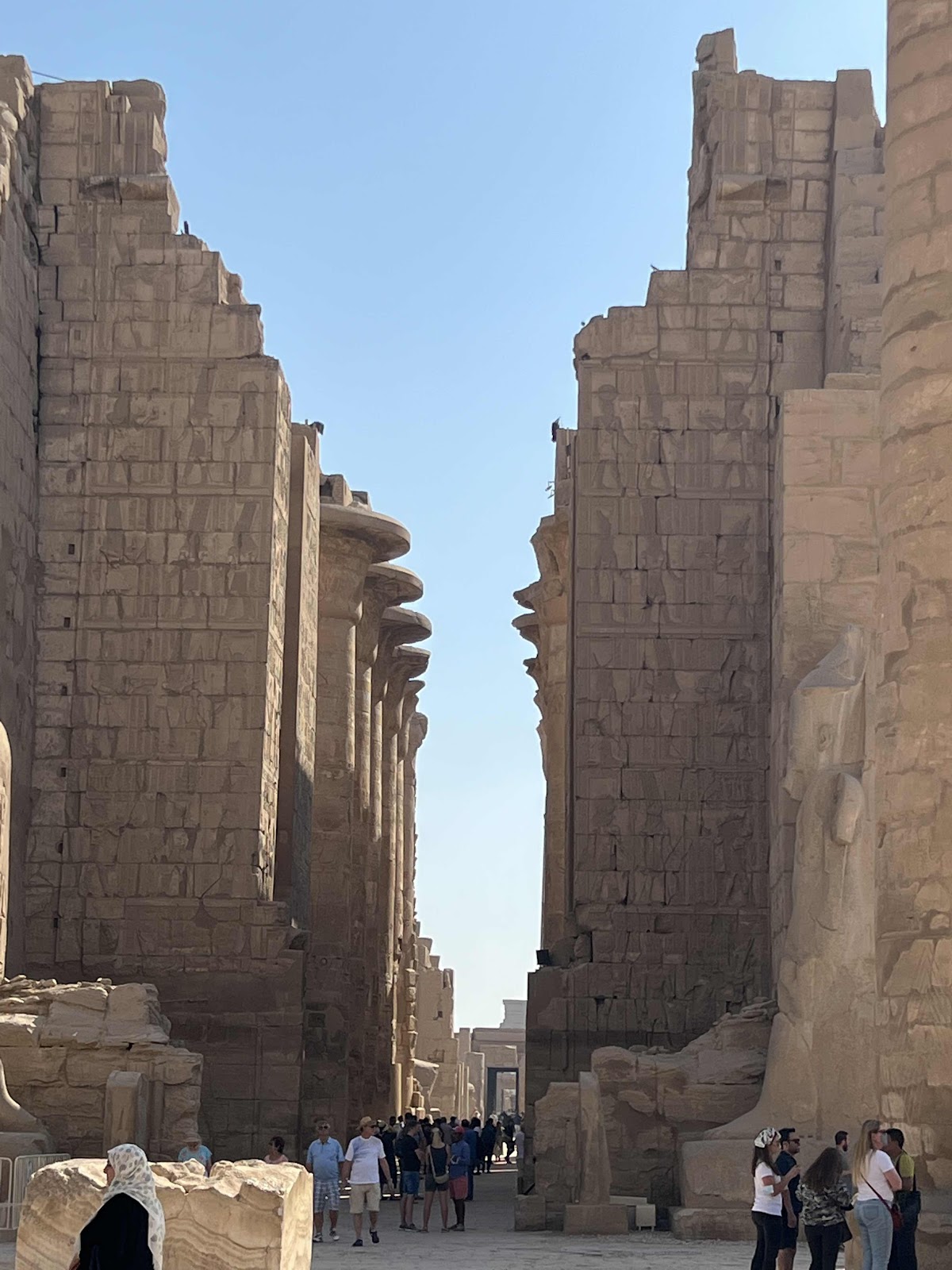
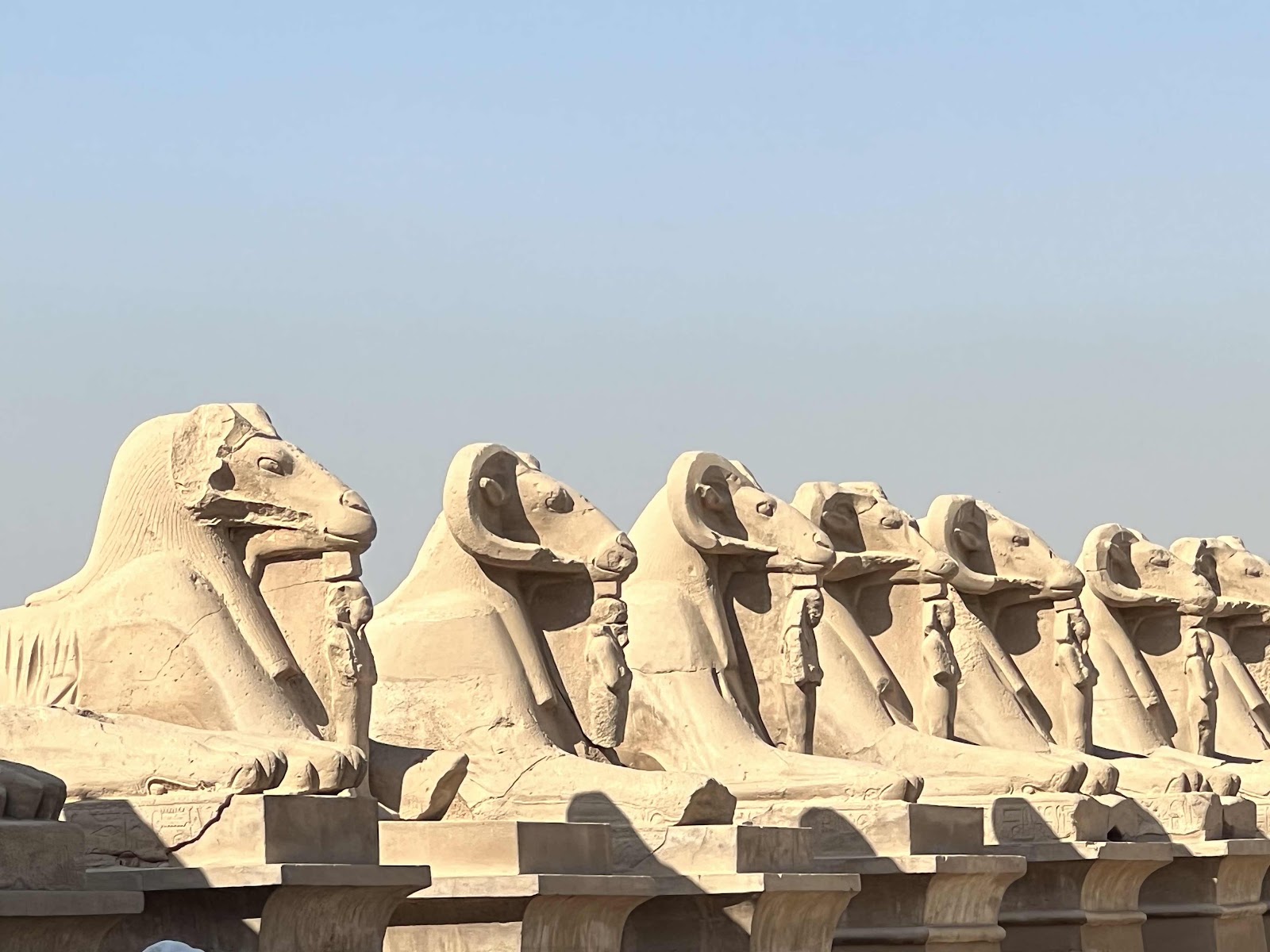
Karnak Temple was built over 2500 years ago.  The first temple was built by Amman circa 1900 BC and added to by successive Pharaohs over 1500 years.  300 BC was the end of the Pharoahanic era.  The Avenue of the Rams is 2 miles long from Karnak to the Temple of Luxor.  The Ram is a symbol of  the God Ammon.

Teti and Ramesses built the Great Hall of Pillars.  There are 134 pillars.  Some have a lotus leaf capital and some have a bundle of papyrus.  They are all covered with hieroglyphs that artistically tell a story of the king and gods.  From right to left will always be the king with his cartouche over his head and he will be offering various things to the god who is on the left.  


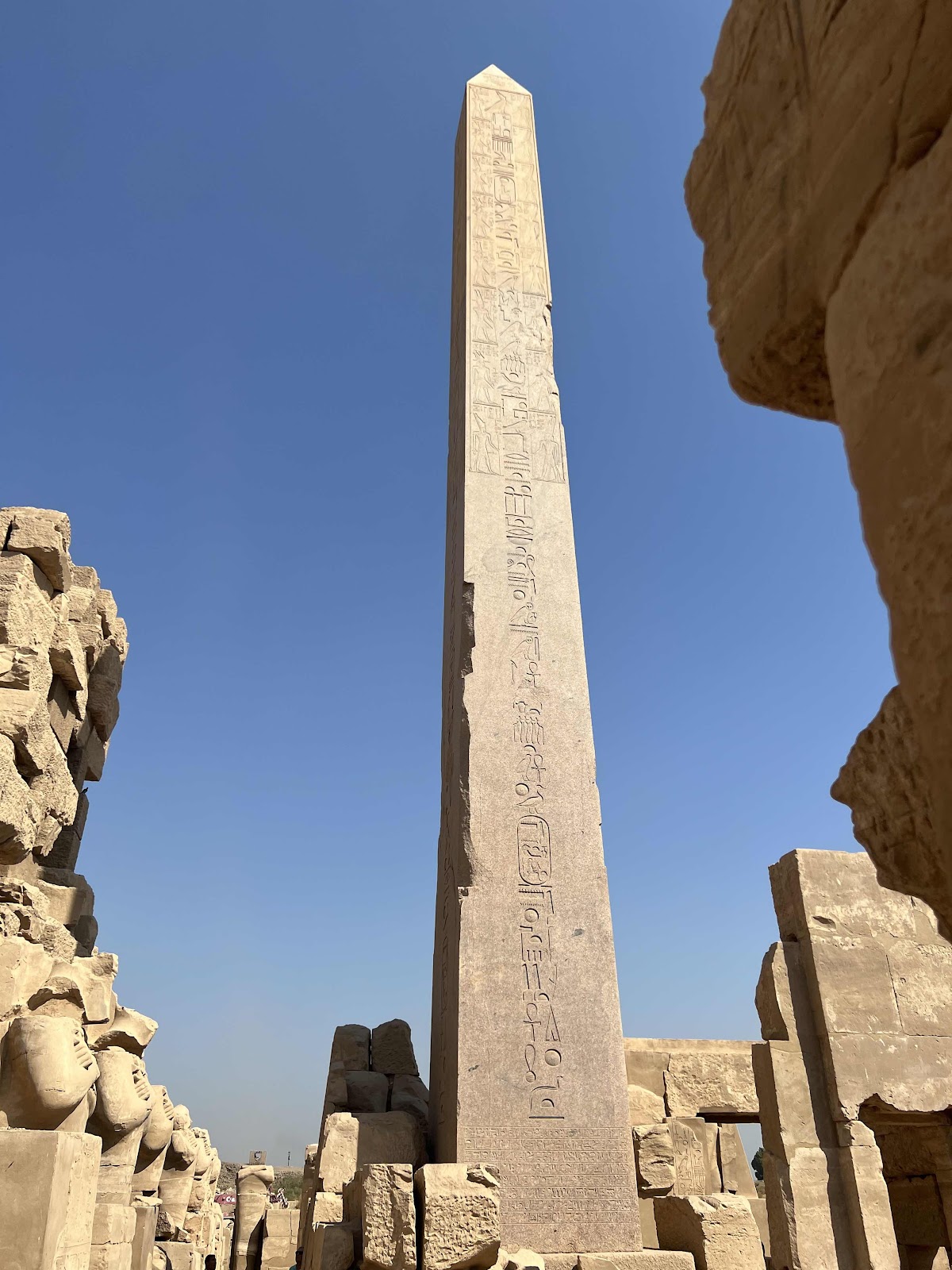
The obilesk is 100 feet tall, weighs 300 tons and is one solid piece of granit.  Queen Hatshepsut commissioned this monument.

The last room in the complex is the actual sacred temple that only the priests can enter. This is where he would make sacrifices (non-human) and keep offerings from the people.  If not cleared out often it would begin to rot and stink. Since this is the temple for Ammon we get the word from this stench - ammonia. 

We waited until early evening to visit the Temple of Luxor lit up with decorative lighting. The crowds were very heavy. Construction in preparation for a visit from the President of Egypt prevented us from getting close to many relics.  In 661 BC, the Babylonians invaded Egypt so many times you’ll see the Roman influence on statues.  The headless statue of Isis shows her in Roman garb.
Another obelisk, one of two that guarded the gate, is 65 feet tall.  The second obelisk was traded to the French for the clock tower mentioned earlier in the Mohammed Ali Mosque.


Hatshepsut built the temple in 1490 BC, Ramesses added the Colonnades in 1390 BC and King Tutunkahman added more pillars in 1320 BC.  A mosque was built over a church in 1200 AD, a Roman temple was added circa 300 BC.

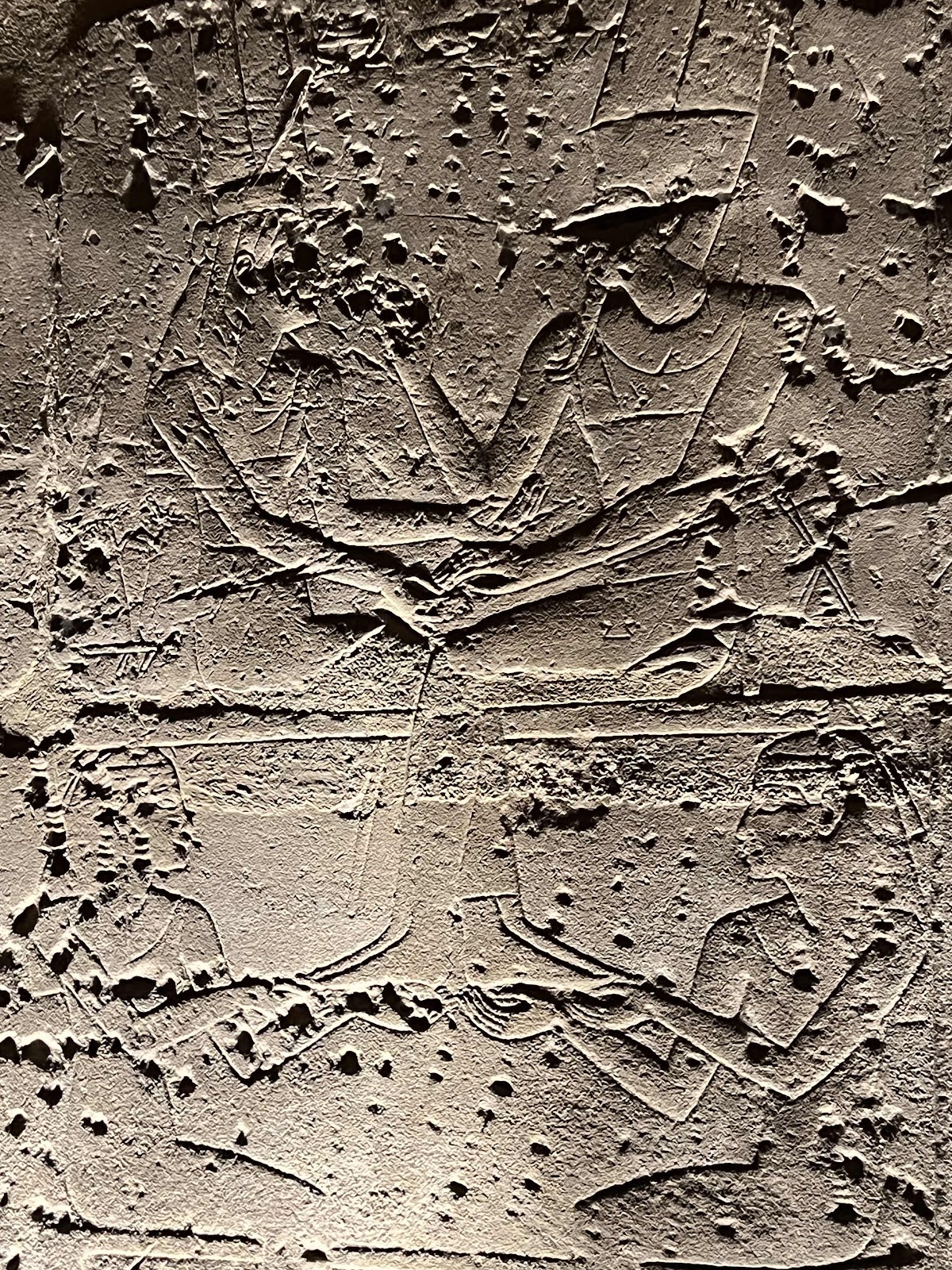
A fun and informative set of hieroglyphs shows god Ammon feeding an ank (symbol of life) into the woman’s nose.  The bent elbow cradled in her hand symbolizes intercourse between the celestial and the Devine entity.  The placement of the legs and feet also suggests intercourse.