Wednesday, March 6, 2019

Pepeéta Tahiti

March 6, Wednesday

Pepeéta (pronounced ‘Poppy-eh-tay” means water basket due to the abundance of natural springs on the island.  Pepeéta has a population of 27,000 and the island has 200,000 people with 80% of them located near Pepeéta or the airport which is in Faaá. I mention this only because I like pronouncing the name - Fa-ah-ah-ah!

A quick city tour took us to the Assembly building where the ‘Queen’s Bath’ is located.  It used to be part of Queen Pomare IV palace but is now part of the beautiful gardens surrounding the Assembly.  As we left the city and suburbs our guide gave us a few facts about the French Polynesian islands such as it encompasses 5 million square kilometers of ocean, 3600 square km of land and 6 archipelagos and 118 islands with 76 islands inhabited. 
The ancient temple - Marae Arahurahu - has a large alter that was used for sacrifices fronted by a large rock plaza and homes or huts for the elders.  The tikis scattered about are to protect the site and the people.

Our next stop was at the Gardens VaiPahi where I really enjoyed all the flowers such as the Porceline Rose of the ginger family, the Monnette and the water lilies.
A local couple who have live on the island for over 40 years in a home that was built in the 1930’s opened their garden to us.  Juliette is very versed in the medicinal qualities of the trees and shrubs found aroun the grounds such as the Noni plant that is a cancer preventative and the Tamanahi oil used for skin problems. She also gave us the full history of the house as we ate fruit grown here.
Our last stop was at the Fern Grotto, a 100 yard deep cave with 10 foot ferns hanging from the cliff overhead.  We might have enjoyed this stop more if it hadn’t been raining.  

Tuesday, March 5, 2019

Bora Bora Snorkeling

March 5, Tues


This day was much like the snorkeling day we had on Mooréa. It seemed like more sharks at this location and the current was not pulling us around which was good.  We stopped at a couple of different sites and we enjoyed it all.
Following lunch we went ashore again to walk around but it was so dang hot and humid that we gave up on that after about 40 minutes and went back to the ship.  Most of the shops were selling black pearls but I’m just not that interested in them.  I did make John stop at a grocery store to buy a bottle of water, some chewing gum and a bottle of sunscreen.  When he saw the price of the sunscreen he about had apoplexy- $23!  I didn’t think it was that bad. 

Monday, March 4, 2019

Raiatea

March 4, Monday

Raiatea (pronounced Rye-a-tay-a) is considered the religious and cultural center of the Polynesia Islands.  During our tour this morning our Polynesian guide pointed out that this island is the center of the islands of Hawaii, Easter Island, New Zealand and islands west of here. He also pointed out that rocks from Raiatea’s temple were taken to the surrounding islands as the beginning of temples on those places.
But first we rode in an outrigger power boat along the shore and up into the fresh waters of the Faaroa (Fa-ah-roe-ah) River.  We went as far as we could before it got too shallow for the large boat.  Ahititi, our tattooed native guide, invited us to join him in a ritual of horn, nose flute, drums and song that he sang to the forest and streams as a way of honoring their spirit and power.  It was from here that the great migration voyages to Hawaii and New Zealand started.

We got off the boat at Marae Taputapuatea, a sacred temple area of great archaeological importance. From here we rode in eight passenger Land Rovers up to the huge crater of a volcano that blew out over a million years ago. Today it is the cradle of agriculture for the island where they grow Mano, papaya, limes, grapefruit, breadfruit, bananas and much more.  There are hydroponic gardens growing lettuce, tomato, cucumber, eggplant and other vegetables. 
Vanilla bean pods growing on vine. 

 Then we saw the best vanilla beans in the world grown under shaded screens dotting the hillsides.  The Tahitian vanilla bean is considered the best tasting but it is a very intensive and time consuming process to grow them.  Each flower on the vine has to be hand pollinated (there are no bees) and it has to be done quickly because they only bloom for 6 hours.  It takes 9 months for the bean pod to grow and it can have only 2 hours of direct sunshine every day.  The pods are picked and dried for another 6 months, then they are massaged to determine their moisture content which has to be at 38%, more or less than that and it goes bad.  When the 38%i is reached they are put into a dark room for 3 months before being sold.  They cost $600 per kilo.

Sunday, March 3, 2019

Stingrays and Sharks

March 3, Sunday

I woke this morning with the back of my legs sunburnt to a point that aloe vera gel was necessary but that didn’t stop us from snorkeling again today.  I just wore long shorts and shirt.


The ship was moored off-shore again of the charming island of Mooréa.  We will be spending several nights here later this week but for today, we enjoyed the warm waters inside the breakwaters, protected from the waves of the Pacific Ocean. A short boat ride took us past the Intercontinental Resort and to the small islets of Tiahura and Fahrenheit where we swam with stingrays, sharks and fish in beautiful coral gardens.  The water was mostly chest high but had a very strong current.  Many tourist were hanging out here as the boat crew spread food to attract the stingrays and black-tipped reef sharks.  But we also saw many other beautiful fish and distinctive coral.


Fighting that current wore us out and made us very hungry!  It’s a good thing we could get a nice big, juicy hamburger for a late lunch!


Saturday, March 2, 2019

Fakarava

March 2 Sat.

After two days at sea with out normal activities we moored off the coast of the island of Fakarava in the French Polynesian chain of islands. Fakarava is a long narrow island - 37 miles long by 13 miles wide at it widest, mere yards at its narrowest. Since the ship is moored off-shore the ship’s life boats are used as tenders to ferry us to shore.
We walked from the jetty carrying all our snorkeling gear and towels through the small village but after about 1/2 mile in the heat we decided that the search for a nice snorkeling spot would go faster if we went back to the jetty and rented a couple of bikes. We found the right spot, snorkeled for a long time then decided to try and find another, maybe more secluded beach along the single paved road.  Ten kilometers later we turned around haveing seen nothing but private homes, palm trees and sand - no beach. And no shade from the relentless sun. 
A small snack shack drew us in for lunch then we snorkeled for a bit before heading back to the ship.  Sweaty, sunburned and tired, we had cool showers, took a long nap then went on a galley tour of the ship’s huge kitchen.
It takes two men to keep the coffe makers working making 100 gallons of coffee each day; they also bake 5,000  of their own breads, rolls, pastries and croissants; 2,000 pounds of meat is cooked daily, and they use 2,300 eggs every day.  The food is kept on two different floors below the galley.

Wednesday, February 27, 2019

Mutiny on the Bounty

February 27, Wed.
The ship stopped at Pitcairn Island for a few hours but we cannot go ashore since they don’t have a dock. The sea is too rough and only 50 people live here so there are no tourist facilities. Due to steep hills most people would not be able to climb up to Adams Town, the only ‘city’ on the island.
If you have read the book or seen the movies of the Mutiny on the Bounty, this place name may sound familiar. The island was first sited and named in 1767 but its location was charted incorrectly.  In 1790 Fletcher Christian and about 11 other sailers acted out a mutiny and sent captain Bligh and half the crew adrift in a small row boat.  When Christian found this island he realized that it was charted incorrectly which would make it difficult for the British to find the mutineers.  So the 27 souls aboard the ship landed and burned the ship.  There were 9 sailors, 11 Tahitian women, 3 Tahitian men, 1 baby and 3 stowaways. They did not all get along. The land was divided unevenly and food was not plentiful.  By 1792 all the Tahitian men were dead, 7 of the sailors were killed and 1 sailor died of natural causes.  The last man alive was John Adams.  From this meager beginning the island has been inhabited (not continuously) by the descendants of Fletcher Christian’s crew.

25 of the current population of 50 people came aboard our ship to talk with us about their home and to sell handmade souvineers, honey, postcards and stamps, t-shirts, hats and books.
The area around Pitcairn and the 4 other islets in this group is the third largest marine protected area in the world at 830 square kilometers (515square miles).  The islands are no closer to each other than 40 miles and up to 360 miles. There are 9 birds and several plants that are only found on this island. A supply ship comes once every three months. They have 3 generators for power, limited internet, rely on radio to communicate with each other, grow their own vegetables, and travel the one road using ATV’s. And yet they seem to enjoy this hard life and hope to attract more people.

Sunday, February 24, 2019

Rapa Nui

Feb. 24, Sunday
Easter Island was first explored by the Dutch who found it on Easter Day 1722.  At that time there were probably 2-3 thousand inhabitants.  A civil war due to overpopulation and deforestation started their decline in numbers.  The Peruvian slave raiding in the 1860’s and European diseases further reduced the population so that by 1877 there were only 111 inhabitants.  It was annexed by Chile in 1888 and now about 60% of the population of 8000 are descendants of the original Rapa Nui.


The reason most people want to visit this island it to see the Moai heads (pronounced Mo-eye).  The Rapa Nui carved these monolithic statues to honor ancestors.  They believed that if the deceased had ‘mana’ or a supernatural power or a close relationship to the gods they needed to honor that person with a Moai.  The quarry was the sides of a volcano where they carved the statues in the rock then gradually they would carve out the rock from under the front of the statue until it could be moved.  These are not just heads but whole bodies, with 2/3 buried underground due to natural erosions and soil deposits.  
Transportation from the quarry to the prepared site for each statue is a mystery since some of these Moai were 20-30 feet tall and weighed up to 80 tons.  It’s possible they cut down trees and used them to roll the statue to its site or they may have stood it up and rocked it back and forth to move it.  Either of these methods would explain the deforestation that took place. They were placed looking towards the land as this allowed them to look over their descendants. Some of these stones are over 1,600 years old.

Ahh Tongariki is the largest platform with 15 statues.  They were knocked down by a tsunami in 1960 but have since been restored.  The largest, 89 ton, Moai is here.  The ‘hats’ are really the Moai hair put up in a man-bun.

Rank Raradu Quarry is where 95% of the heads were carved.  Almost 400 statues are around the crater in various stages of completion.


Tents in the background where we enjoyed our barbecue dinner & entertainment. 
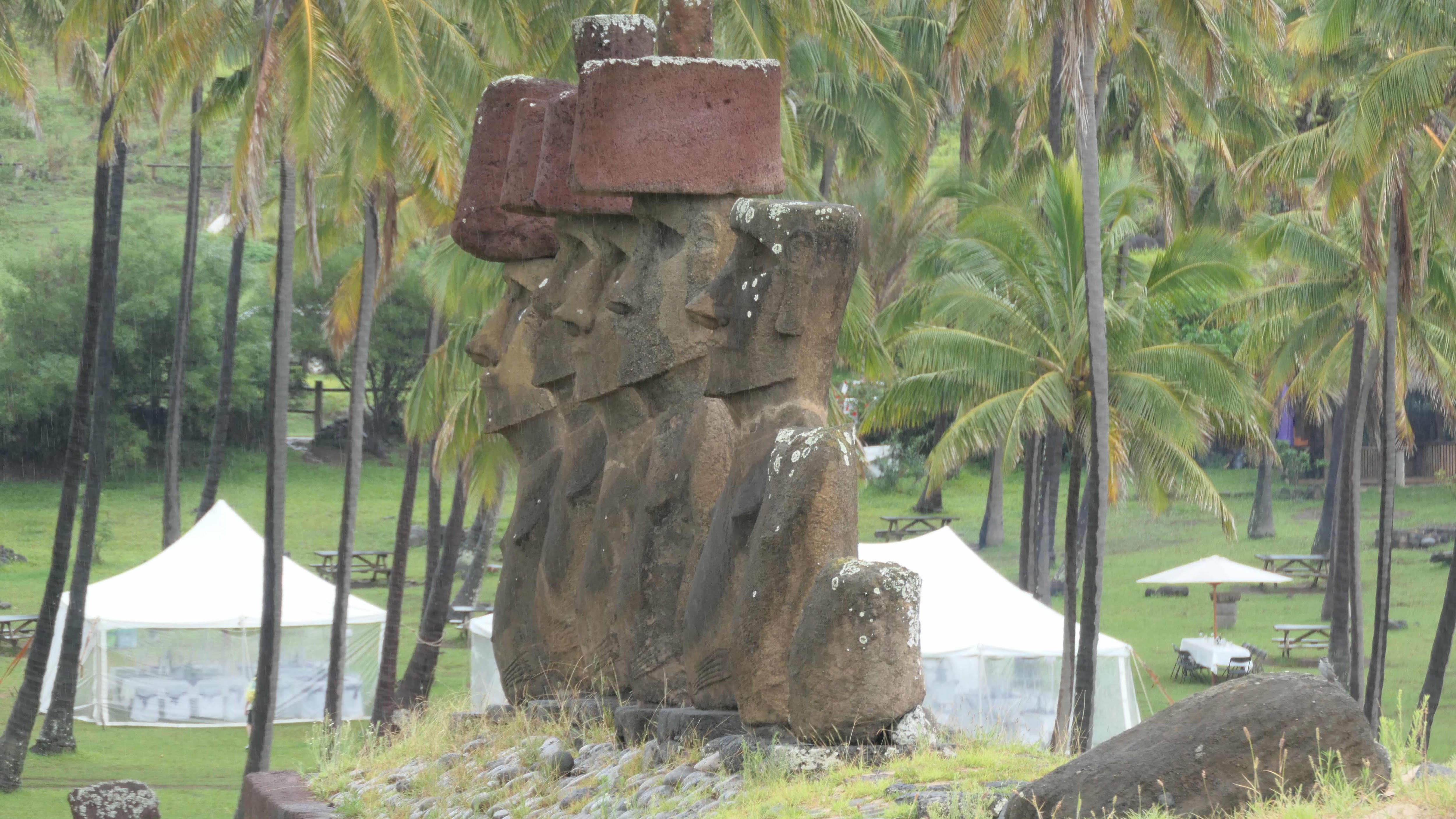
Anakena Beach is protected and used by many locals.  The statues here represent the seven sons of a king.
A barbecue lunch was waiting for us on the beach and the entertainment following the meal was so much fun.  It brought to mind the Disney movie “Moana”.

Wednesday, February 20, 2019

Crystal Cruising

Feb 19 - 23 Tues - Sat

We left our B&B at noon and by 1:30 we were in our stateroom and had explored the ship enough to find a hamburger for lunch.  The ship pulled out of dock around 7 PM and we are on the way to Easter Island, a five day cruise.
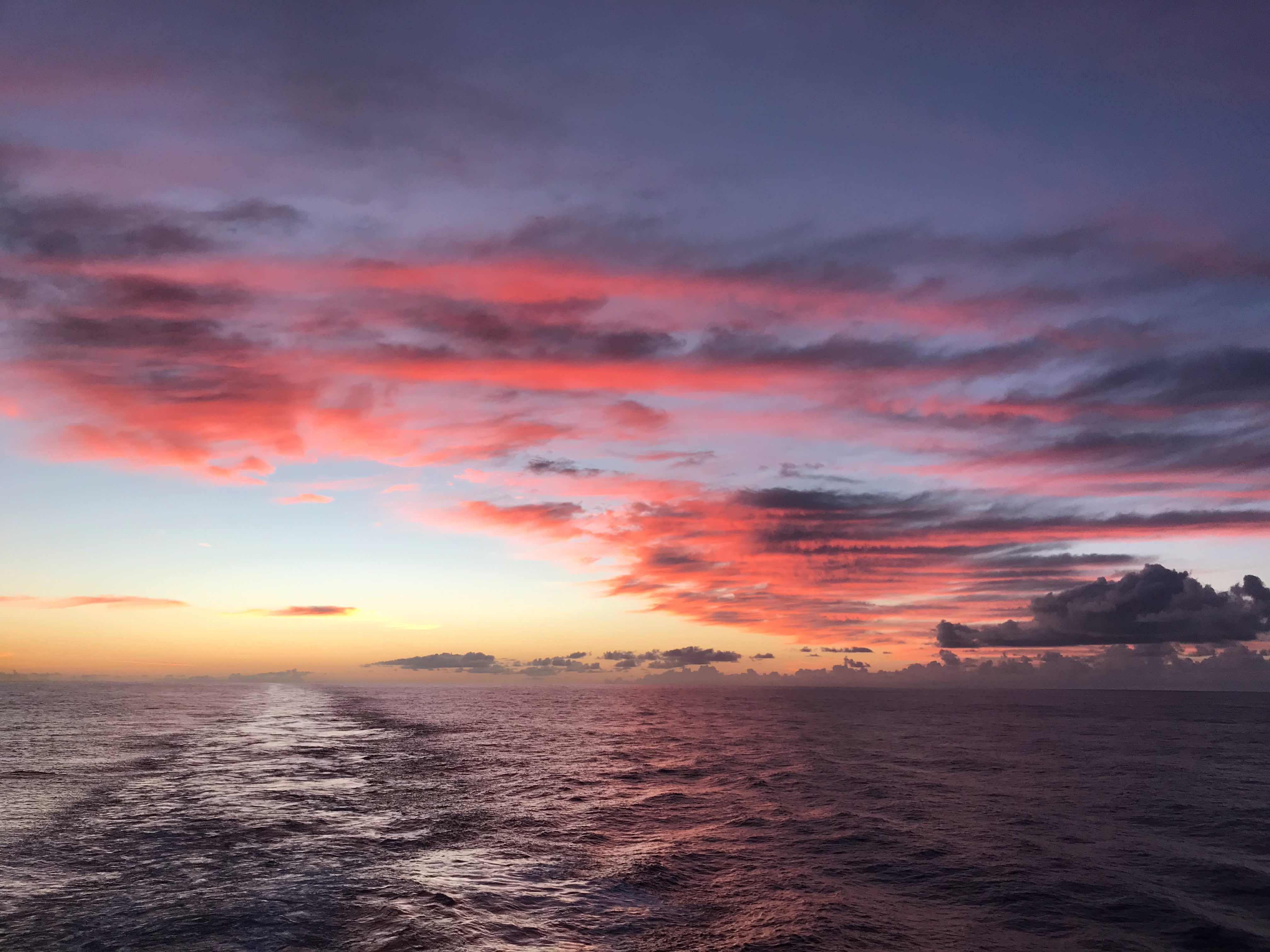
Sunrise at sea. 
There is lots to do while we are at sea.  For art lovers there are knitting classes, water color paint classes or bridge lessons.  If we wanted we could learn how to use our laptops or cameras.  Numerous fitness classes are offered such as pilates, yoga, spin, golf lessons, paddle tennis and much more.  They have a fairly complete fitness room with connections to the steam or sauna rooms.  And of course, there is the Spa for anything from facials, to pedicures, massages to acupuncture, hair cuts to keratos treatments for rich, shiney hair.  We also have access to the swimming pool and hot tub or we can lounge on the aft decks in the morning sun with drink service there as well.  Deck 7 is for walking - one mile is 3.7 laps.  There is also outdoor fitness equipment for a complete workout.

We are on a VIP level so we have out own private butler who shines shoes, brings ice three times a day and supplied us with a liter of Jamison and a bottle of champagne.  Everyday at 4:30 we find hor’dourves  in our stateroom like crab claws, tuna tartar, beef tartar, shrimp cocktail, and crudités or chips and peanuts. We always have fresh fruit.  Since we hadn’t done laundry for several weeks, we took advantage of the guest laundry and got our clothes pressed.

We have seven restaurants to choose from for meals, high tea every afternoon, and at least 5 bars.  John likes the casino.  We are entertained daily with music from piano, violin, guitar or Jazz at various times and locations, a movie theatre and the nightly stage production.  On top of all that there are 2-3 lectures everyday on topics like ET, astronomy, Easter Island, and the author of the books on which the TV show “Bones” is based.

If anyone gets bored on this ship, its their own fault.

Monday, February 18, 2019

On to a New Adventure

February 18

After warm goodbyes to all our new friends this morning we boarded a plane to Santiago then transferred to Valparaiso where we will start our cruise across the Pacific to French Polynesia and Tahiti!

Since we arrived at our B&B in the Historic District in mid afternoon we took a walk around and up and down the hillside upon which the city is located.  At first we thought this area had a severe graffiti problem but on closer inspection we realized that a lot of the paintings were really good pieces of art. We would have included other works but power lines obscured parts of the art.  People are walking everywhere as this is a summertime destination!


Sunday, February 17, 2019

Saying Goodbye to Patagonia

February 17, Sunday 
Las Torres Hotel waiting to cross the river. 
It started raining yesterday evening and it rained all night and most of the morning. After supper last night, our driver Turu moved the bus across the river, which was already water covered, to high ground.  We were due to depart at 8:30 this morning but there was no way to get passengers and luggage across the flooded river. It took three hours for the hotel to work out a plan of egress.  At one point they talked about putting us on an inflatable boat!  For awhile the hotel vans were able to cross but the river kept rising.  About 11:30 we boarded 4x4 pickups, riding in the back with the luggage, and crept across the swollen waters.  The water came up to the floorboards but we all made it across safely.

We still had a 6 hour drive plus stops for lunch, gas, and potties but made it to Punta Arenas by 6 and were ready for dinner at 7. It was a beautiful evening at the private home of Edwardo who is the manager of Wilderness Travel in Chile. We had king crab, scallops, abalone and ceviche as appetizers,; wine, beer and Calafate berry pisco sours to drink; and a corn and chicken casserole for dinner.
After our leader Karen spoke each group member commented on the trip and I sang the song I had written about our trip.  And to top it off Edwardo played the guitar and his wife and daughter sang beautiful Chilean songs.  We then had fun trying to sing American folk songs but we could never remember all the words.  Lots and lots of laughter!
Plans are already in the works for this group to gather for a similar trip to Norway in 2020!

Saturday, February 16, 2019

Last Hike

February 16, Sat.
The day dawned with rain and high winds but we dressed for the weather and started out anyway. Our goal was to climb 2300 ft to the Base of the Torres (towers) lookout, about 5 miles up. About a mile into the hike most of us decided we had had enough of the high winds (estimated at 35-45 mph) throwing the rain and possibly some sleet into our faces. Five hardy souls plus our guide, Carlos, pushed on. We were told they only made it another mile or so before conditions worsened and they turned back before they could be pushed off the mountain!
Plan B - Turu drove us to the top of a saddle at the edge of the park and we hiked about 3 miles through meadows filled with guanacos, a relative of alpaca and camels. We also kept an eye out for a puma but we never saw her.  The wind was much less here and the rain let up so it was a pleasant way to spend part of the afternoon.

I added up the number of miles we hiked over 11 days and it came to 73 miles but my Fitbit recorded 114 miles and 274,000 steps!!!